Showing posts with label writers. Show all posts

Sunday, April 3, 2022

The Writer and Positive Thinking


By Karen Cioffi

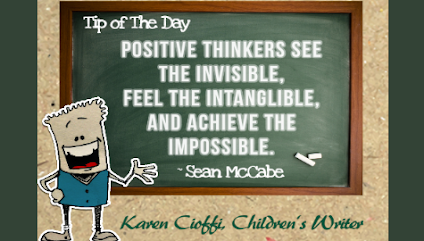
 When I was looking for a house a few of years ago, I saw this quote by Sean McCabe, and it amazed me how accurate it is.

As my husband and I were looking, my husband saw all the things wrong with each house. It had wall paper; it needed a complete renovation; it needed a kitchen; the basement needed to be finished; the rooms weren’t right. The lot was too big. It was a corner property. The list went on and on.

I saw all the things right with each house. I saw how it could be. I have the ability to look beyond what’s actually there (see the invisible and feel the intangible) and see what can be.

It made me think about writing. Most writers understand that writing can be a tough business. There are lots of rejections and lots of ups and downs. To survive in this business, you need to keep a positive mindset. You need to persevere. You need to see beyond the slumps. You need to keep moving forward and achieve what may seem impossible.

This also goes for those who want to be an author but have no clue how to go about doing it. Seeing things through a positive mindset allows you to figure out what to do, whether it means hiring a ghostwriter or taking the steps necessary to learn to write yourself.

But it goes beyond writing. As with everything in life, there will be obstacles in your path. Sometimes those obstacles may seem insurmountable. The key is to not let them stop you. Keep moving forward. You might even envision yourself happily beyond the problem or obstacle.

So, whether it’s with your writing life or life itself, be a positive thinker.

See the invisible and the intangible and achieve the impossible.

ABOUT THE AUTHOR

Karen Cioffi is an award-winning children’s author and children’s ghostwriter, rewriter, and coach with clients worldwide. She is also the founder and editor-in-chief of Writers on the Move and an author online platform instructor with WOW! Women on Writing.

Karen’s children’s books include Walking Through Walls and The Case of the Stranded Bear. She also has a DIY book, How to Write Children’s Fiction Books. You can check all her books: https://karencioffiwritingforchildren.com/karens-books/. If you need help with your children’s story, visit: https://karencioffiwritingforchildren.com.
 

Tuesday, April 30, 2019

Attend that Conference


         All professionals attend conventions, conferences, in-service, or workshops to increase their knowledge in their field, to reinforce what they know, and to learn how to manage their business efficiently. This need to participate in conferences applies to writers as well as doctors, CEOs, and teachers.
         I am attending a conference this coming weekend (the OWFI conference, named one of the top conferences in the Southwest) the first of May, and I want to share why I attend conferences.


Why Attend a Writing Conference?


          Writing conferences increase the possibility of attendees improving their skills, gaining confidence, and building a better presence in their field.

         Most writing conferences have sessions over writing skills. At the LexiCon Writers Conference (several years ago), I presented a session titled “How to Write That Children’s Book.” According to feedback after the hour’s class, attendees discovered how to begin and to write their stories, some things they hadn’t realized were needed. A few said they didn’t realize action was required in a children’s story. At the Oklahoma Writers' Federation Inc. (OWFI) conference, I attended a session concerning romantic suspense given by best-selling author Merline Lovelace . I learned how to balance the two components and follow the writing arc.

         One session covered creating and keeping an effective blog. One of the tips concerned limiting categories used. Another, encouraged bloggers to post regularly. A tip that caught my attention, a blogger should be aimed toward the desired audience, rather than to others in the same profession. Therefore, the need for a new blog.

         A problem area for most writers includes the need to treat their profession as a business, when in today’s publishing world, it must be. Part of the business needs included promotion of the writers’ product: books. Sessions by social media and public relations experts gave suggestions and solutions that allowed attendees to better understand how and why to address their business.

         Other benefits of attending conferences include networking and opportunities for writers to "pitch" their manuscripts to agents, editors, and/or publishers. Being able to interact with other writers helps authors understand the challenges they face aren't only theirs, that others have those obstacles, also. Networking allows writers to learn from others and to help others. Friendships develop that last a lifetime. However, networking and pitching need articles of their own.

         Once a writer gains more knowledge, or reinforcement of what they already know, and learn how to better manage their business, their confidence increases. As a result, writers are better prepared to face their writing world. 


Sunday, February 5, 2017

Book Marketing - Even Tiny Action Steps can Produce Huge Results


"Someone is sitting in the shade today because
someone planted a tree a long time ago."

By Karen Cioffi

This Warren Buffet quote inspires me. It's simple, yet so amazingly powerful. 

1. A tiny seed can create something as massive as a tree, even a sequoia tree.
Think of the giant sequoia tree in California, USA. It averages around 26 feet in diameter, weighs around 4,189,000 lbs. and reaches heights of 275 feet. According to Wikepedia, "Record trees have been measured to be 311 feet in height and over 56 feet in diameter. The oldest known giant sequoia based on ring count is 3,500 years old."

The seed of the sequoia tree is 0.16–0.20 inches long, 0.039 inches broad, and 0.039 inches wide.

Hard to imagine, isn't it.

Well, this can easily relate to writing, to content marketing, to business . . . to just about everything in your work and life.

Small positive actionable steps, no matter how tiny, can create massive results. You may think your writing and marketing efforts aren't moving you forward, but think of how long it takes that tiny seed to grow into that tree that gives shade.

2. Basic action steps to move your author/writer platform forward.

A. Everyone selling something online needs a website. So, the very first step is to create one or have one created.
B. Make your website work for you by publishing blog posts to it regularly. This strategy will create visibility, bring people to your site, build your authority in your niche, and boost sales.
C. Share your blog posts on social media networks, such as GooglePlus, Twitter, and Facebook.

3. What you sow today can have benefits for many tomorrows.

Time will pass whether you take action or not. If you have an idea, take action now. Don't wait for tomorrow or until you have more time or until you have more money. Take action now. The benefits may turn out to be bigger than you could possibly imagine.

You may reap the benefits of your writing or content marketing or business efforts far into your future, so take that initial step. Or, maybe it's expansion that you're thinking about, or a new strategy.

Keep in mind though that every living thing needs sun, water, and food to grow. So, when you take that step (plant that seed), be sure to give it the nurturing it needs to become what you believe it can be.

Plant that seed today!

Karen Cioffi is an award-winning author, children’s ghostwriter, and content marketing instructor. Get weekly must-know writing and marketing information and more, right to your inbox. Join Karen Cioffi in The Writing World. (It’s all free!)

Sunday, December 4, 2016

Do You Still Need a Website as the Core of Your Online Platform?

By Karen Cioffi

A few years ago I wrote an article about the need for home business websites. I explained the reasons a website was an absolute must and gave a couple of statistics proving that need.

Since then, social media has exploded. It’s become more powerful than ever, and more and more people and businesses are using it as an integral part of their marketing strategy.

In fact, the social engines are now an essential element of brand visibility, website traffic, and building authority to all size businesses. It’s gotten to the point where some are questioning the need for a website.

Are websites for marketing really a thing of the past?

Here are three reasons for that question:

1. Some might reason that you can blog on venues like LinkedIn. You can also publish articles on EzineArticles and other article directories to generate visibility and authority.

2. If you’re selling a product or service, you can use social networks to do so by linking to your Amazon or other sales page.

3. Want to let people know about you and what you do? You can do that on your social network pages. You can even build your subscriber list through social media.

So, it’s not unreasonable for some to wonder about the necessity of a website.

But, if you decide to forgo the website or get rid of an existing one, think twice and even three times about it.

The benefits of a website

While the social media sites, like Facebook, Twitter, and LinkedIn allow for just about everything you need to market you and your product/service, you’re at the mercy of these sites.

Pro internet marketer and entrepreneur Sandi Krakowski has over 1 million Likes on her Facebook page. And, she has over 1 million clients, which allows her to produce millions in revenue. She knows what she’s talking

In a recent email from Sandi, she said, “If you don't have a website, listen to me very carefully, you own NOTHING online. You're homeless. You have no real estate, you are under the control of someone else's property and when push comes to shove, you my friend are in a big pickle!”

Did you notice she said you don’t have control with social media sites?

Think of it as renting space in a building. Or, better yet, buying within a condominium development. You’re not in control. You’re at the mercy of their rules and regulations, their changes, their agendas, basically, their whims.

Want to change the exterior color of the building? Want to do major construction inside?

You’re at the mercy of the owner’s permission.

In other words, you’re not in control.

This is the same as using sites like Facebook and GooglePlus. You never know when or if changes will come that will render your social media page useless.

This is why you still need your own website.

If you use paid website hosting through sites like Bluehost, you own the site. It’s yours. You are in control of what you publish, how you publish, and so on. You can choose your own theme with the header dimensions and design you want. You can put ads and affiliate links on it with no problem. You can sell from it.

Along with this, people trust bloggers. This gives bloggers influence and authority. It’s good marketing to have that authority, that influence, go to your own site.

Bottom line, as an author / writer, you still absolutely need your own website!


Knowing what to do and ‘not do’ is an important aspect of online marketing. Karen Cioffi’s new CREATE YOUR WORDPRESS WEBSITE TODAY (no code, no technical stuff, no fuss ) e-class through WOW! Women on Writing shows you how to build your online foundation.
CLICK HERE FOR DETAILS!

Wednesday, December 11, 2013

Write THAT book

by Suzanne Y. Cordatos
www.suzannecordatos.blogspot.com


Boots crunch on six inches of new powder and carve a fluffy white trail up the Connecticut hills. Like a scene on a greeting card or a Norman Rockwell painting, we drag an empty red sled and carry a rugged knife capable of allowing a suburban family to saw a perfect 7-foot pine from the tree farm a short drive from our new house. My preschoolers run and hug one of the first trees they see and declare it perfect. Feeling like a lumberjack, my husband gets to work with the saw and the fresh pine smell rushes our senses with nature’s holiday goodness as our fingers get sticky with the resin we can’t help but touch.


“I have no memory of that – of a real tree in the house,” my now-teenage daughter announced the other day as she made up her own verses singing “Deck the halls and fluff the branches! Fa la la la la-a-a-, la la la la!” She referred to our family’s annual ritual of fluffing the plastic Christmas tree branches to look more real, spreading the packaged greens apart while I silently regretted not buying a pack of “pine scent sticks” to tuck into the tree branches. Then it hit me: How did I succumb to this fake tree? When did I allow this change to happen to my family? What do you mean you have no idea what a fresh pine tree smells like at Christmas?!?


It's beginning to look a lot like Christmas,
but what happened to the pine smell?
Writers, it is up to us. 

How might city kids learn about the woods or a farm if they have never visited one? When a girl loves to dance, can she imagine herself on stage? What does it feel like under the hot lights in front of an audience?There’s probably a book for that—and if there isn’t? Write THAT book!

Prolific American author Jane Yolen has a lot to say about what and how to write in her book, Take Joy. Her advice on what should go into your writing? "The wind in your hair, the slate of sky overhead; a child's quick intake of breath". In other words, the little discoveries that perhaps only you have bothered to notice. Cultural holiday traditions from far away or long ago can feel as alive as a simmering pot when you read about them in a storybook; the tinkering of tools in a workshop crafting homemade wooden toys; the warmth of Mom’s kitchen, her flour-coated hands expert on the rolling pin or helping pudgy little fingers press hard enough on the cookie cutters; tangible vibrations of voices lifting together in joyful song to the heavens.

When writers describe life’s moments (big or small, important or seemingly trivial) through words and characters and stories, we offer readers a window into an experience they might completely miss out on otherwise. Not just pretty holiday moments, either. Young people learn empathy by identifying with a character and experiencing tragedy or illness without having to go through the trauma themselves. Through books, we get inspired to discuss ethical dilemmas and explore different paths our lives might take. If we didn't learn about life through books, our world would be limited indeed. 

Please share one of your special holiday moments – it is important! Let’s not miss out!
Happy Holidays, everyone!

Monday, May 13, 2013

What Does Grammar Have to Do with Anything?

by Vivian Zabel  

    A while back,  I wrote about the need for writers and/or editors to use good grammar whenever they write (check for article here). Some people argued that worrying about grammar stifles creativity. I disagree, and I'm not the only one.  Using correct grammar adds to a person's qualifications and credibility.

    In that article I briefly mentioned that often people in business are promoted, or not, based on their grammar usage. Oh, my, one would think I had torn a hole in a valuable painting. However, my research shows I'm correct.
 
     Some writers fight the idea that grammar (including sentence structure, punctuation, subject/verb agreement, pronoun usage, spelling, etc.) impacts the worthiness of writing, which is like saying failing to lay a solid foundation does not impact the stability of a building. However, many people don’t realize that the use of grammar influences a person’s future in business from being hired, to receiving promotions, to validity as a professional.

      Speech and English instructors inform students that how they speak and how they use their language can determine whether an employer hires them or not. Many applications include the need to write a paragraph. Those who evaluate the applications read the paragraph to gain knowledge of the applicants education in language usage. During an interview, if an applicant uses correct grammar and word usage, he will be considered over another applicant with the same credentials but poor grammar and speaking ability. A person doing the interview will become distracted by incorrect grammar and rough speaking patterns, and the applicant loses in the process.

    According to Naphtalia Leba as well as other experts, poor grammar and word choice leads to unclear communication. Kyle Wiens, CEO of iFixit, (Harvard Business Review, July 20, 2012) states he will not hire people who use poor grammar. “I have a zero tolerance approach to grammar mistakes that make people look stupid.”

       Once a person is hired for a position, he faces the possibility of promotion and pay raises. Kyle Wiens’ article includes the following:
          
           Good grammar makes good business sense — and not just

       when it comes to hiring writers. Writing isn’t in
       the official job description of most people in our
       office. Still, we give our grammar test to
       everybody, including our salespeople, our operations
       staff, and our programmers.

      He continues to show that grammar does have something to do with job performance, creativity, and intelligence. If someone can’t properly use “it’s” after many years, then that person has a defective learning curve. People who make fewer mistakes on a grammar test make fewer mistakes in other activities not related to writing, such as stocking shelves or labeling parts. People who care about grammar (the details of good writing) also care about other details.

     Cheryl Conner, in her article for Forbes (March 11, 2013), gave the results of a study involving English-speakers in industry. 1. Professionals with fewer grammar errors in their profiles had achieved higher positions. 2. Fewer grammar errors correlate with more promotions. She cites Brad Hoover, CEO of Top Ten Reviews who says grammar skills indicate the following positive workplace traits: Attention to detail; critical thinking; and intellectual aptitude.

     The use of poor punctuation, grammar, and word choice leads to unclear communication. If a person’s writing is confusing, if his spoken words are unclear, confidence in him will be poor, too. The adherence to the “rules” helps build a positive impression involving client relationships, communicating with co-workers, and impressing employers.

     As Naphtalia Leba  added, “Unclear, confusing or ambiguous writing causes misunderstanding and misinterpretations. These can lead to costly mistakes, hurt feelings, lost money, and legal issues.” The same is true of unclear, confusing or ambiguous speech.

    Proper grammar usage is important not only in writing stories, novels, and other books, but also for writing in business and for use in speaking.  

Sunday, July 8, 2012

A Few Tips for Writers

by Vivian Zabel


     I'm a fan of writing magazines: The Writer, Writer's Digest, and a few others. I find suggestions that help me as a writer, and some times, I find things to ignore. The recent issue of Writer's Digest had many tips, good ones worth sharing. I'll give a brief, partial list of tips all writers many find helpful.

  • Unique shouldn't be modified with very, more, rather, or so. Unique stands alone.

  • A message I repeat over and over: Avoid multiple exclamation points, and I add, "Use only in dialogue and then seldom."
  • Know the difference between their, there, and they're. Their means belonging to them. There is a place, as is here. They're means they are.
  • Writers should have professional quality as their goal, not perfection.
  • Don't write about anything you don't care about.
  • Fiction will be smoother if the simple replaces the complicated.
  • Give your writing time to rest between revisions.
  • Use very and rather seldom, if at all. Don't be lazy, find a precise word.
     Hope those few suggestions help you be a better writer. To discover more tips try reading writing magazines in print or online.


4RV Bookstore 

Monday, June 25, 2012

How to push your book designer over the edge

by Vivian Zabel 

        Your book is edited; you and the editor think it is finished; the department head proofed it and sent it to the designer for formatting; the designer, who is not an editor but has formatted and helped copy edit enough manuscripts to recognize some common problems recognizes that more work is needed, or not. She formats and sends a PDF proof to the author, the proof reader, the editor, and the person who pays the bills. She asks everyone to go over the proof carefully and thoroughly. She gives directions as to how she wants each person to send his/her comments, changes, and solutions to problem areas each finds. One, yes, just one, person followed her request. She ends up with four documents, all "organized" or "disorganized" differently and hard to follow. She wants each change/suggestion/comment in order from front of the manuscript to the end, not jumping from one section to the other, but most don't list the problems areas in order.

        That problem is enough to push the designer over the edge, but then she looks at one of the documents. The person who sent the document doesn't understand some of the more elementary grammar or writing necessities. When a designer, who is NOT an editor, recognizes the problems, maybe it's time authors and editors do, too.

        Here are a few examples of what should already be known by writers and by editors:

1.  Dad, Mom, Sis, Grandpa, and other nouns are not capitalized IF an adjective is before it. For example, your mom, not your Mom; my grandpa, not my Grandpa.

2.  A character's thoughts are italicized and the words I, my, mine, or any other first person pronoun doesn't have to be included in the wording to make thoughts. They are words that the narrator wouldn't/shouldn't use as part of the narration -- unless the manuscript is written in first person.
      For example: Mary walked toward the door. Why shouldn't the world stop spinning for her. No, she gets everything she wants. The italicized words are not something the narrator should be writing, but something Mary thinks.

3.  Thoughts, which are italicized, must make sense as thoughts. Words spoken should not be confused with words thought by a character.

4.  Editors or authors who are not sure about something should get help from someone who does know before telling the designer to do something wrong.

5.  If each person involved in the copy edit sends in his/her revisions, sending in contradictory revisions for the same exact problems, the designer is forced  to make a judgement call or pester the boss. Each successive person should read the preceding person's edits. The designer follows the following chain of command: The author is outranked by the the editor; the editor is outranked by the department head, who is outranked by the company head. Everyone usually finishes proofing a proof at different times; therefore, seeing what others said first would help a person see if he or she agrees or not. A quick email would help each person better understand why or why not.

6.  Follow the style manual of the publishing house that is doing your book. Read it, refer to it, refer to it again, read it, follow it.

        I'm sure other things make a book designer want to snatch him or herself bald, but those are a few that can be easily fixed, if a person really wants to be a better writer or better editor.

Sunday, September 4, 2011

The best online writers conference I know

by Vivian Zabel 

The Muse Online Writing Conference is the best online conference I've found, and it's free. It allows those who can't attend a conference physically to have a chance to learn more about writing, submitting, promotion, and other aspects we need to know.

Registration closes September 25, so people MUST register now:  After that the forum link to register will disappear .

Also, the conferences has pitch sessions, where writers can pitch their manuscripts to agents and/or publishers. Check out the line up so far for workshops and pitch sessions, read the guidelines what and how to submit your pitches:


I hardily recommend this conference. 4RV Publishing will have a forum, and I'll be holding a workshop forum, too.


4RV Publishing  
4RV Bookstore