Showing posts with label positive thinking. Show all posts

Sunday, April 3, 2022

The Writer and Positive Thinking


By Karen Cioffi

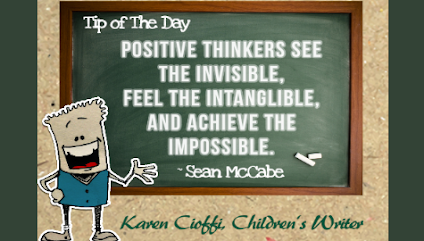
 When I was looking for a house a few of years ago, I saw this quote by Sean McCabe, and it amazed me how accurate it is.

As my husband and I were looking, my husband saw all the things wrong with each house. It had wall paper; it needed a complete renovation; it needed a kitchen; the basement needed to be finished; the rooms weren’t right. The lot was too big. It was a corner property. The list went on and on.

I saw all the things right with each house. I saw how it could be. I have the ability to look beyond what’s actually there (see the invisible and feel the intangible) and see what can be.

It made me think about writing. Most writers understand that writing can be a tough business. There are lots of rejections and lots of ups and downs. To survive in this business, you need to keep a positive mindset. You need to persevere. You need to see beyond the slumps. You need to keep moving forward and achieve what may seem impossible.

This also goes for those who want to be an author but have no clue how to go about doing it. Seeing things through a positive mindset allows you to figure out what to do, whether it means hiring a ghostwriter or taking the steps necessary to learn to write yourself.

But it goes beyond writing. As with everything in life, there will be obstacles in your path. Sometimes those obstacles may seem insurmountable. The key is to not let them stop you. Keep moving forward. You might even envision yourself happily beyond the problem or obstacle.

So, whether it’s with your writing life or life itself, be a positive thinker.

See the invisible and the intangible and achieve the impossible.

ABOUT THE AUTHOR

Karen Cioffi is an award-winning children’s author and children’s ghostwriter, rewriter, and coach with clients worldwide. She is also the founder and editor-in-chief of Writers on the Move and an author online platform instructor with WOW! Women on Writing.

Karen’s children’s books include Walking Through Walls and The Case of the Stranded Bear. She also has a DIY book, How to Write Children’s Fiction Books. You can check all her books: https://karencioffiwritingforchildren.com/karens-books/. If you need help with your children’s story, visit: https://karencioffiwritingforchildren.com.
 

Wednesday, July 22, 2020

Three Tips to Banish Stress


Your editor is screaming for the changes to the article you promised her two days ago; the kids are yanking on your arm because they are bored; and you still haven’t figured out what’s for supper tonight.

Is it any wonder you have a tension headache?

According to a National Health Interview Study, abut 75% of the population feels stress every two weeks. Stress can affect your eating habits, sleeping patterns, blood pressure, skin appearance, and weight. In extreme cases, it leads to death.

So, what can you do about stress? More than you think.

Stress Trigger #1: I can never accomplish everything on time.

If you’re feeling overwhelmed, then you are probably spending too much time thinking instead of doing.

Tip: Create a to-do list. Write down everything you have to do over the next week and view it with a critical eye. Does everything on this list really need to be accomplished next week? Is there something that could wait another week? What tasks have deadlines cannot change?

Prioritize your tasks. Then work on them one at a time. Don’t think about the next thing on your list. Concentrate only on the task at hand.

If you will miss a deadline, don’t pile on additional stress by waiting until the last minute to let the editor know. This will keep you from wasting time worrying over what she’ll say.

Stress Trigger #2: My family believes I dedicate too much time to my writing career.

Finding the perfect balance between your home life and career is never easy, but there are many things you can do to gain the support of your family.

Tip: Have a family meeting. Explain to your family why pursuing a writing career is important to you. Share your dreams with them and what you hope to accomplish.

Ask for their help. You can’t do this on your own. Once you’ve shared your reasons for choosing a writing career, let them know how they can support you.

• Share household chores
• Respect your writing time
• Run errands

This only works, however, if you respect your family time. Create a writing schedule that works best for you and stick to it. At the end of your writing time, shut off the light and close the door. Your family will be more willing to help if they know that once you’re done for the day, they are your top priority.

Stress Trigger #3: I keep putting things off. Then I get stressed trying to finish by the deadline.

Procrastination is an issue for many writers. Reasons for putting things off vary: over commitment, lack of confidence in your abilities, and allowing distractions and interruptions to steal your writing time, to name a few.

Tip: Learn to say “no.” If you over commit, then you will feel stressed and put things off. Frequently turning in projects late can damage your reputation and cost you repeat business. Saying “no” does not make you a rotten person. You are only saying “no” to this one thing. That doesn’t mean you won’t be able to help the next time someone asks.

Self-doubt, fear of failure, and fear of success are actual issues for writers because they deal with rejection. Use positive self-talk and focus on your strengths. Write a list of all your strengths and pin it above your desk. When you wander away from a project, read the list and then get back to work.

Two excellent resources that discuss ways to handle self-doubt and fear are You Are More Than Enough: Every Woman’s Guide to Purpose, Passion & Power by Judi Moreo and Page After Page by Heather Sellers.

Don’t let distractions and interruptions steal your writing time. Schedule a time each day to return phone messages and check email. Your writing time is for writing. Don’t use it to wash the dishes or run errands. Let your family know they are more than welcome to interrupt you for a genuine emergency, but they have to respect your writing time.

Reducing stress is not only good for your career, it’s good for your health. Take the time to identify what triggers stress in your life and never shy away from asking for professional help if you need it. You owe it to your family and your career to stay healthy.


Cheryl C. Malandrinos is a freelance writer and editor. She is the author of four children’s books including, A Christmas Kindness, released by 4RV Publishing. A blogger and book reviewer, she lives in Massachusetts with her husband and two daughters. She also has a son who is married. Visit Cheryl online at http://ccmalandrinos.com and her children’s book blog at https://childrensandteensbookconnection.wordpress.com

Wednesday, October 24, 2018

How Can Writers Use Positive Thinking?


Many years ago, I challenged my online writing group to draft an end of the year review that outlined only the positives of their writing journey. They could share anything they wanted, but it had to be framed in a positive light. Not only did our members enjoy looking back in a positive way, they realized just how much they actually accomplished.

But what is positive thinking? How does it work?

What is Positive Thinking?

Positive thinking is more than just uttering a few happy words and then allowing your fears and self-doubt to take hold again. Positive thinking is a mental attitude that, with practice, allows you to have positive thoughts and uses daily affirmations to help you to see a positive outcome to almost every situation.

Judi Moreo, life coach and author of You Are More Than Enough: Every Woman’s Guide to Purpose, Passion & Power, encourages her readers to make conscious choices to think about themselves in a more positive light. Moreo says we must stop criticizing ourselves and demanding perfection in what we do, and that we need to change the mental pictures we have of ourselves. Through the use of daily affirmations and by visualizing our success, we can achieve the desired results.

Daily Affirmations and Creative Visualization

Daily affirmations are positive thoughts you can affirm throughout the day to uplift you and make you feel better about yourself. Judi Moreo uses them throughout You Are More Than Enough because, as she says, “Changing your life is a process.” Positive thinking isn’t something you can use randomly. If you want it to work, you have to practice it every day.

Moreo dedicates an entire chapter in her book to creative visualization. She says that you can use your imagination to create pictures of those things that you want “to be, do, and have.” On the flip side, you can also imagine that you aren’t able to accomplish what you want because you aren’t smart enough or good enough. Which person do you want to be?

How Positive Thinking Molds Your Future

If what we see is unmet goals, then there is no desire to move forward. Why would we expect anything to change? When we focus on all the good that came out of our efforts, not only do we feel a sense of accomplishment, we can consider changes to help us achieve more goals in the future.


How Can Writers Use Positive Thinking? 

At the beginning of this year you--hopefully--wrote down a list of S.M.A.R.T. goals. Then you broke down that list into smaller, more manageable chunks before creating weekly or daily to-do lists.

Look at your goals and all you’ve accomplished this year. What do you see?

My goals for 2018 included:

GOAL 1: Submit Clever Tom to agents
GOAL 2: Participate in STORYSTORM
GOAL 3: Blog twice a week on all four blogs

So what have I accomplished?

GOAL 1 (not exactly)
GOAL 2 (yes)
GOAL 3  (mostly)

Clever Tom is a children's story I had a ton of fun writing. Something (I couldn't put my finger on what) held me back from submitting it to agents. I tweaked it and then tweaked it some more. I reread it numerous times. Finally, it hit me--it's too long. Just the other day, I sat down with the story again and made the last edits to cut out over 300 words.

Did I meet my goal? Not yet, but on a positive note the story is better because of it.

STORYSTORM is an annual event to generate story ideas. This year I met my goal of 30 story ideas for the month of January and celebrated with a great big ice cream sundae. Rewards help you accomplish more too!

When setting the third goal, I knew it was aggressive considering my limited writing time. But who doesn't love a challenge? I began time blocking my calendar more regularly and have increased my blogging time this year. That's a win as far as I am concerned.

Looking Forward

Use these last two months of 2018 to move ahead with a positive attitude and see what else you can accomplish before Father Time pushes us into the new year. This will give you a head start on practicing positive thinking by the time January rolls around. Then use daily affirmations to keep you focused on the positive and visualize your success.

You have the power to make 2019 your most productive year yet!


Cheryl C. Malandrinos is a freelance writer and editor. She is the author of Little Shepherd, A Christmas Kindness, Macaroni and Cheese for Thanksgiving and the recently released, Amos Faces His Bully. A blogger and book reviewer, she lives in Massachusetts with her husband and two daughters. She also has a son who is married. Visit Cheryl online at http://ccmalandrinos.com and her children’s book blog at https://childrensandteensbookconnection.wordpress.com