Showing posts with label Karen Cioffi. Show all posts

Sunday, November 6, 2022

How to Give Basic Writing Advice


Contributed by Karen Cioffi, Children's Writer

 A while ago, I was asked to look over a children’s fiction picture book manuscript. This was not a paying job, just a favor.

The ‘new to writing’ authors, who are both health care professionals, had already been calling major publishers to find out submission requirements. They were told their manuscript would not be looked at without an agent.

So, they went to the library to find a book on top agents.

While this is a worthy endeavor, there are some basic first steps to take before shooting for the stars.

Just glancing at the manuscript, I knew it needed a lot of work. And interestingly, I was surprised to see so many errors in a simple 600-word story.

It seems as we progress in learning the craft of writing, we forget that we didn’t know the very basics at one time either.

So then, I had to figure out what to say to the authors without alienating them or totally discouraging them.

When critiquing or giving writing advice, it’s important to begin with the positive aspects of the manuscript. If the errors are basic and there are a lot of them, you may also want to state them in generic terms, not to offend the author/s.

What does this mean?

Well, it’s not a good idea to say, “You shouldn’t have the children’s picture book manuscript formatted in lists, numbered, or in Australian Sunrise 10pt font.”

Instead, you might say, “Manuscripts are usually preferred typed in New Times Roman 12pt font, and are double spaced using a free form flow with the first sentence of each paragraph indented.

See the difference?

To help with clarity, you could include a first page example of a manuscript you have, or rewrite the 1st paragraph of the authors’ manuscript.

If there are just too many errors, for time’s sake you can make a list of proper manuscript formatting tips. This is the approach I took.

I started out with the ‘positive:’

This is a wonderful idea for a children’s book and has great potential, especially that both of you are professionals in the health field. Children will certainly benefit from the story’s information. It could use some tweaking, though.

Then I added the following:

Here are a few tips for writing and formatting a manuscript to help get it submission ready:

•    Manuscripts should be formatted in 12 pt Times New Roman Font
•    They should be double spaced
•    They should be in free form without numbering for pages or in list form
•    The first sentence of each paragraph should be indented
•    Children love action – actions are better shown through ‘showing’ rather than ‘telling’
•    Notes for illustrations after each of your intended pages are usually frowned upon by publishers
•    Most publishers, especially the major ones use their own illustrators
•    Manuscripts are more likely to make it past the slush pile if they are polished
•    Usually writers go through a process of one or two critique groups and writing groups. After rewrites and editing it gets to a point where it looks perfect. That’s when it needs to be professionally edited.

These tips are part of the advice I offered the authors and I kept it as generic as possible.

After you note the manuscript errors, you should end your advice on another positive note. You might say, “With rewriting and editing, you will have an engaging story that children will be sure to love, and it’ll be submission ready.”

I then provided several writing links about writing for children and editing.

Since every author’s personality is different it’s usually best to use the gentle approach when offering writing advice.

ABOUT THE AUTHOR


Karen Cioffi is an award-winning children’s author and children’s ghostwriter, rewriter, and coach with clients worldwide. She is also the founder and editor-in-chief of Writers on the Move and an author online platform instructor with WOW! Women on Writing.

Karen’s children’s books include “Walking Through Walls” and “The Case of the Stranded Bear.” She also has a DIY book, “How to Write Children’s Fiction Books.” You can check them out at: https://karencioffiwritingforchildren.com/karens-books/. If you need help with your children’s story, visit: https://karencioffiwritingforchildren.com.  


Monday, October 3, 2022

Book Marketing - Every Author Needs to Know About It


By Karen Cioffi

I used to write a lot about book marketing and content marketing but I’ve gravitated more toward writing, specifically children's writing over the last eight or so years.

The thing is, while writing has a beginning, middle, and end, marketing and selling your book is never-ending … if you want to sell books.

This is why knowing about book marketing is crucial to every author.

When I read Neil Patel’s article on his content marketing formula, I knew I had to share it.

Before I dive in, let me explain these terms.

Book Marketing

This marketing strategy is ‘everything’ you do to bring visibility to your book and actually sell it.

While there are some authors who just want to have a book written and don’t really care about selling it, most authors want to sell their books.

This is especially true of authors who spend money to self-publish their books where costs can be from under $1,000 to well over $5,000.

A few of my clients have spent well over $10,000 for just ONE book.

Recouping the money invested in your book is a big deal to most.

And, it’s just as important if you’re traditionally published. Your publisher will definitely want you to help sell your book/s.

In fact, it you and another author both submitted great manuscripts to a publisher, a determining factor on who gets the contract could be who has a better book marketing platform.

So, here are a few elements to know about before and after your book is available for sale:

1. Create a book worthy of publishing and learn about pricing it effectively
2. Create and maintain an author website
3. Write articles and post them on your website’s blog
4. Be active on social media and share your blog posts and those of other users
5. Get an email list going and maintain it
6. Look into guest blogging and interviews
7. While doing all this and more, start on your next book

Once your book is available for sale, you’ll also need to get book reviews and create an Amazon Author Page.

Content Marketing

This strategy is about writing and sharing content to your specific target audience.

According to Content Marketing Institute, “Content marketing is a strategic marketing approach focused on creating and distributing valuable, relevant, and consistent content to attract and retain a clearly defined audience — and, ultimately, to drive profitable customer action.”

To clarify a bit, it’s about bringing visibility to you and your product/s through content (things you write and share, like your blog posts). It’s about building a brand (what you want people to think of when they see your name or logo).

The marketing world is driven on content.

Below are a few strategies of content marketing:

1. Blogging
2. Video
3. Podcasts
4. Infographics
5. Sales pages on your website
6. Books

There are many other elements that go into these marketing strategies, but this should give you a basic understanding of both these terms.

And more importantly, it’s important to understand that pretty much everything you do to sell your book is a form of content marketing.

Now on to content marketing expert Neil Patel’s tips.

1. Optimize your headline.

Everything you write, whether a blog post or a description on social media, starts with a headline.

An example of this is the title of this article.

There are thousands and thousands of tidbits of information online, why would someone click on your bit of information?

The very first reason would be the headline. It’s what will initially grab the reader’s attention.

2. Add three internal links.

Internal links bring the reader from one page on your website to another.

It allows you to bring the reader at your website to other pages on your website and/or blog posts through clickable links.

3. Share your content on social media.

Once you put up a blog post, use sharing tools, and share it to your social networks.

4. Message everyone you link out to.

This tip pertains to external (outbound) links. Links from your website (usually from your blog post) to other websites.
http://www.writersonthemove.com/2018/01/seo-for-authors-part3-outbound-links-in.html

Patel recommends that you contact the site you’re linking out to and let them know that you’ve linked to their site from your blog post or webpage.

Ask the site to stop by and share the article.

5. Email blast your new blog posts.

Email your subscribers every time you post new content.

To learn the basics of email marketing, check out this article:
Email Marketing – 10 Top Reasons to BE Doing It
http://www.writersonthemove.com/2017/01/email-marketing-10-top-reasons-to-be.html

I know some of this may sound too complicated, but just knowing the basics will be of tremendous benefit to you.

So, give your book every chance at finding readers and making sales.

For a more in depth look at marketing your books, check out
Build Your Author-Writer Platform
http://wow-womenonwriting.com/classroom/KarenCioffi_WebsiteTrafficInboundMarketing.php 

ABOUT THE AUTHOR 


Karen Cioffi is an award-winning children’s author and children’s ghostwriter, rewriter, and coach
with clients worldwide. She is also the founder and editor-in-chief of Writers on the Move and an author online platform instructor with WOW! Women on Writing.

Karen’s children’s books include “Walking Through Walls” and “The Case of the Stranded Bear.” She also has a DIY book, “How to Write Children’s Fiction Books.” You can check them out at: https://karencioffiwritingforchildren.com/karens-books/. If you need help with your children’s story, visit: https://karencioffiwritingforchildren.com. 

Sunday, September 4, 2022

Are You Showing or Telling?


By Karen Cioffi

I've written about showing and telling before, but it’s such an important topic that I think more information is always helpful.

Writing is an ongoing adventure…always something to learn and tweak and hone. A while ago I wrote a children’s story and found I still had a bit of showing in it. This was noted by writing coach and children's author Suzanne Lieurance who gave it a critique.

I was toying with the idea of submitting my story as a picture book, but was advised it would work out better as a children’s magazine article, unless I wanted to rewrite it specifically for a PB.

Anyway, I noticed that when I write, and I think this goes for most of us, my thoughts precede my reading and writing ability – so I don’t catch my own errors.

This happens because I know what I wrote and what I intend to convey. This makes it almost impossible for a writer to edit her own work. You can get close, but as the saying goes, Almost Doesn’t Cut It.

What do I mean? Well, let’s look at a simple sentence:

In a daze, Pete stumbled to his feet.

While this isn’t the exact sentence in my story, it is similar. I revised my article and reread it numerous times and didn’t notice that “in a daze” is telling, not showing. And, what’s the KEY to writing in today’s fast paced, no time to waste world? FOCUS AND TIGHT WRITING.

In fact, the fast-paced reader of today is getting even more impatient and ready to move on in the blink of an eye. So, we need to take this into consideration in our writing and marketing.

Okay, back to the focus of the article…

So, how do we change the above sentence into a showing only sentence?

Dazed, Pete stumbled to his feet.

Really simple when you are able to actually read what is written rather than already know what you intended.

What are the important tips to take away?

1. Make sure you are part of a critique group. These groups can be super-helpful. If you’re a children’s writer, you can find one in the forum of Society of Children’s Book Writers and Illustrations (SCBWI). There’s a yearly fee, but it’s worth the investment.

2. Belong to writing groups in the genre you write. You can usually ask questions and get answers.

3. If your budget can afford it, get at least one grammar editing tool. I use Grammarly and ProWritingAid. They may not specifically tell you you’re ‘telling’, but they will tell you if you’re using passive writing.

Just be careful not to depend on these tools solely. I’ve had both tools miss an ending dialogue punctuation on a client’s work.

4. Do not submit your work to a publisher or agent before you’ve edited it and proofed carefully. It’s important to have someone who knows how to write to review or critique your manuscript for you (if you’re not already a part of a critique group).

5. If it’s in your budget, have it professionally edited.

For more on showing versus telling visit:
https://karencioffiwritingforchildren.com/2017/05/14/writing-showing-vs-telling/ 

ABOUT THE AUTHOR

Karen Cioffi is an award-winning children’s author and children’s ghostwriter, rewriter, and coach with clients worldwide. She is also the founder and editor-in-chief of Writers on the Move and an author online platform instructor with WOW! Women on Writing.

Karen’s children’s books include “Walking Through Walls” and “The Case of the Stranded Bear.” She also has a DIY book, “How to Write Children’s Fiction Books.” You can check them out at: https://karencioffiwritingforchildren.com/karens-books/. If you need help with your children’s story, visit: https://karencioffiwritingforchildren.com. 

Sunday, July 3, 2022

Can All Kid's Stories be Turned Into Books?


By Karen Cioffi

 As a children’s author, editor, and ghostwriter, I’ve only seen one story that couldn’t tweaked, nudged, shaken, or even deconstructed and reconstructed into a publishable story.

The concept and author of that one book were, well, not quite all there. Dealing with so many clients, I’m surprised I’ve only had one so far.

Aside from that, though, most stories or drafts can be magically turned into something an author will be proud to be author of.

A big problem I see is that new authors sometimes don’t know what a publishable story is.

But, wait a minute …

Let me clarify what I mean about a publishable book because today, any story can be published, whether poorly written or well written story.

When I use the term “publishable,” I’m talking about a book that meets the standard children’s U.S. publishing guidelines.

Three of the top mistakes I see that would warrant taking another stab at your story or demolishing it and starting over are:

1. The point-of-view

You’re writing a picture book or chapter book and have more than one point-of-view (POV).

This can happen when you have two or more main characters in your story, or it can occur if you have head-hopping in your story.

Let’s go back a step and define POV. Every story has to be told from someone’s perspective. In other words, who is the story about?

It’s essential in young children’s writing that you clearly define who the protagonist (main character) is. And, there should only be one.

Jerry Jenkins, the author of over 190 books, says he avoids slipping into an omniscient viewpoint “by imagining my Point of View or Perspective Character as my camera—I’m limited to writing only what my character ‘camera’ sees, hears, and knows.”

So, POV is a critical element of your story. Check to make sure you have only one POV and it’s that of the protagonist.

Head-hopping is slipping from one character’s POV to another within the same page, paragraph, or sentence.

In the example below, Tommy is the protagonist:

Tommy dug his cleats in. He raised the bat to his shoulder. A second later, he watched the ball heading toward him . . . like a torpedo out of its tube. Without blinking, he swung the bat. CRRAACCK. Stunned, he dropped the bat and ran. Did . . . did I just hit the ball.

“Pete,” said Jim with a nudge, “you see that. I didn’t think he’d hit that ball—it came so fast.” Jim threw a pretend pitch. “Look at him running round the bases.”


The second paragraph in the example is a no-no. It brings Jim’s perspective into the story since Tommy couldn’t see or hear him.

Tommy is the protagonist and must know what’s going on in the story, or it can’t be in the story.

This could be rewritten, though:

Tommy dug his cleats in. He raised the bat to his shoulder. A second later he watched the ball heading toward him . . . like a torpedo out of it tube. Without blinking he swung the bat. CRRAACCK. Stunned, he dropped the bat and ran. Did . . . did I just hit the ball.

When Tommy raced to home plate, he heard Jim yelling, “I didn’t think he’d hit that ball—it came so fast.”


Now it’s all from Tommy’s point of view.

2. Adults save the day.

Children want to read about children. They want the protagonist to solve his own problem.

While parents or other adults in a story can be a support system, their involvement needs to be minimal. The young protagonist needs to come up with the solution to her problem.

Using “Stephanie’s Ponytail” by Robert Munsch, Stephanie wants to be unique. Here’s how the story starts:

“One day, Stephanie went to her mom and said, ‘None of the kids in my class have a ponytail. I want a nice ponytail coming right out the back.’”

The problem, though, is the day after Stephanie comes in with that particular ponytail, all the girls in her class have it. So, each day she tells her mother to create another specific kind of ponytail. The day after each new ponytail, the class copies her.

At the end, Stephanie comes up with a clever and funny idea that cures the class of copying her.

While the mother is involved in the story, it’s Stephanie who comes up with all the ideas. And it’s Stephanie who solves the problem.

3. Jumping in without learning how to swim first.

You’ve wanted to write a children’s book for years. You have tons of ideas, and you’ve even written a couple down. It’s gotten to a point where you can’t wait any longer; you put one of your ideas into a story.

You type or write away and finally, you have your story, and it seems great.

-Picture books can be 10 pages, right?
-You ‘kind of’ draw, so you can create your own illustrations, right?
-You have a couple of rhymes here and there, so that’s good, right?

While you may have a great story idea, standard picture books are usually 32 pages, and of those pages, 24-26 are for story and illustrations. Unless you’re a professional illustrator, you shouldn’t create your own illustrations. And, either you’ve written a rhyming story or not.

There are lots of other elements that you need to be aware of before jumping in to write a publishable book.

So, there you have it, three top children’s writing mistakes.

If I were to give a number 4, it would be that you have TOO much showing in the story. If I were to offer a number 5, it would be that you’re trying to knock the young reader over his head with the moral of the story.

Hope these tips help you when you sit down to write your story.

ABOUT THE AUTHOR


Karen Cioffi
is an award-winning children’s author, a successful children’s ghostwriter with 300+ satisfied clients worldwide, and an author online platform instructor with WOW! Women on Writing. For children’s writing tips, or if you need help with your children’s story, visit: https://karencioffiwritingforchildren.com

You can check out Karen’s books at:
https://karencioffiwritingforchildren.com/karens-books/


Sunday, June 5, 2022

Make Your Fiction Story Work


By Karen Cioffi

 Think about the last time you read a story that stayed with you. A story that made you feel. A story that took you on an adventure or had you sitting on the edge of your seat. A story that made you cry or laugh ... or think.

These types of stories have it. They have the key to making a story work.

So, how do you go about creating a stirring story?

Here are 5 top tips to writing a fiction story that works:

1. It’s got to have conflict.

All writers have heard this and the reason is because it’s true.

Your protagonist MUST be striving for something, and it should be something significant. She needs to have obstacles in her way that she has to overcome in order for the reader to be engaged enough to turn the page.

The reader has to be pulled into the story wondering if, and more so hoping that, the protagonist reaches her goal.

You wouldn’t have much of a story following a couple in an amusement park going from ride to ride, waiting on line for food, and so on. There’s nothing for the reader to get involved with. There’s no emotional element.

Or, what if a great writer puts two children in a story that takes place at the Bronx Zoo. The narrator describes in detail all the exhibits they visit and does it wonderfully. But, what does the reader have to sink her teeth into. Nothing.

One of my all-time favorite movies was Thelma and Louise. The conflict was never-ending. And, it was the conflict that keep you on the edge of your seat.

How would they get out of the mess they were in?!

That’s how you want your readers to feel. There needs to be conflict in order to make the reader feel. It doesn’t have to be ‘seat of your pants’ drama, but it needs to be significant. It can be external or internal, but it has to be something the reader can grab and hang on to. It has to make the reader get involved with the story and care about it.

2. The readers need to be invested in the story.

A good story brings the reader into the protagonist’s shoes. This is what will motivate the reader to like and root for the protagonist.

It’s all about making the reader ‘feel.’ The story has to evoke emotion on the reader’s part. The story has to have substance.

Going back to Thelma and Louise, one wrong decision spiraled out of control into what seemed to them as a live or die situation.

Circumstances and choices took them bounding out-of-control, as if caught up in a tornado. This kind of story creates investment.

It evoked emotion in just about everyone who saw the movie. Everyone was rooting for the protagonists.

In an article, “Make Readers Deeply Connect to Your Characters,” the author calls this key factor, “transportation.” You’re bringing the reader out of their reality and into your story world. You’re transporting them.

Like Alice when she steps into the rabbit hole. Down, down, down she went into another world.

3. The characters have to act ‘real’ and be likeable.

Your characters need to be multifaceted. They need to behave like real people. This means they’ll have good traits, but they’ll also have some bad traits or weaknesses. It may be they’re indecisive. Or, at the beginning of the story they may be frightened of everything.

Your characters should make great decisions, but they should also make poor ones.

Along with this, your protagonist needs to be likeable. He needs to have traits that the reader will admire and connect to. It’s important that the reader likes the protagonist.

Maybe your protagonist will be honest, heroic, responsible, generous, or loyal.

You get the idea. These are characteristics that most people admire in others. They’re characteristics that will draw the reader in.

I forgot what movie it was and I forgot the exact details, but basically the protagonist was sitting in a diner across from her date. Another woman, elegantly dressed, walked passed with toilet paper stuck to the bottom of her shoe. The toilet paper woman was heading to a table where a man was waiting for her.

The protagonist excused herself for a moment. She got up and removed the paper from the woman’s foot by walking behind her and stepping on the paper. Then she sat back down and returned to her conversation.

The woman that passed by never knew the kindness the protagonist showed her. And, the protagonist didn’t mention what she did to her date.

This one simple act of kindness spoke volumes about the character of the protagonist. She’s the type of person you’d admire and like to be friends with.

4. The protagonist needs to have some heroic qualities.

At some point in the story, the protagonist needs to step up. This can be in several small incidents that she overcomes throughout the story. Or, it can be in one climatic incident that wraps the story up.

In general, and especially in children’s stories, the protagonist needs to take action and reach her goal.

It may be after one or two or three failures, but ultimately, the protagonist must step up. Whether it’s physical or emotional, whether internal or external, she needs to fight through all obstacles that stand in her way.

Readers want a purposeful story. They want and even expect the protagonist to be victorious. Don’t let your readers down.

5. Tie-up all loose ends.

When you’re getting to the end of your story, make sure all loose ends are tied up. Any tidbits of information you put out there must be resolved.

You want the reader to go away satisfied. You don’t want her wondering why something was mentioned somewhere in the story and not resolved.

One example is mentioning that the protagonist’s close friend lost his dog. Then there’s no mention of it. Was the dog found?

WHAT HAPPENED TO THE DOG?

Another example is in a middle-grade manuscript I read. The author had the friend of the protagonist saying he couldn’t go to the protagonist’s special event because he had something URGENT to do that day.

Afterward there was no mention of the urgent matter.

This is a NO-NO. What was so urgent? Why was it mentioned, if it wasn’t followed up with?

As I read the manuscript I knew that part would either have to be addressed (tied-up) or eliminated.

These loose-ends are things that will gnaw at the reader. They will finish the book feeling like something is missing. Again, this is a NO-NO.

So, there you have it.

While there is more involved in writing good fiction, these five are at the top of the ‘good fiction story’ list. 

ABOUT THE AUTHOR


Karen Cioffi
is an award-winning children’s author, a successful children’s ghostwriter with 300+ satisfied clients worldwide, and an author online platform instructor with WOW! Women on Writing. For children’s writing tips, or if you need help with your children’s story, visit: https://karencioffiwritingforchildren.com

You can check out Karen’s books at:
https://karencioffiwritingforchildren.com/karens-books/


Sunday, April 3, 2022

The Writer and Positive Thinking


By Karen Cioffi

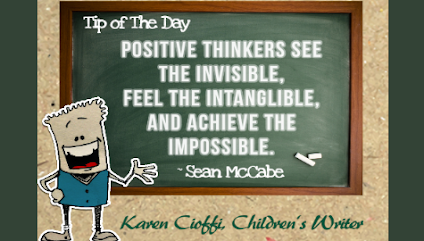
 When I was looking for a house a few of years ago, I saw this quote by Sean McCabe, and it amazed me how accurate it is.

As my husband and I were looking, my husband saw all the things wrong with each house. It had wall paper; it needed a complete renovation; it needed a kitchen; the basement needed to be finished; the rooms weren’t right. The lot was too big. It was a corner property. The list went on and on.

I saw all the things right with each house. I saw how it could be. I have the ability to look beyond what’s actually there (see the invisible and feel the intangible) and see what can be.

It made me think about writing. Most writers understand that writing can be a tough business. There are lots of rejections and lots of ups and downs. To survive in this business, you need to keep a positive mindset. You need to persevere. You need to see beyond the slumps. You need to keep moving forward and achieve what may seem impossible.

This also goes for those who want to be an author but have no clue how to go about doing it. Seeing things through a positive mindset allows you to figure out what to do, whether it means hiring a ghostwriter or taking the steps necessary to learn to write yourself.

But it goes beyond writing. As with everything in life, there will be obstacles in your path. Sometimes those obstacles may seem insurmountable. The key is to not let them stop you. Keep moving forward. You might even envision yourself happily beyond the problem or obstacle.

So, whether it’s with your writing life or life itself, be a positive thinker.

See the invisible and the intangible and achieve the impossible.

ABOUT THE AUTHOR

Karen Cioffi is an award-winning children’s author and children’s ghostwriter, rewriter, and coach with clients worldwide. She is also the founder and editor-in-chief of Writers on the Move and an author online platform instructor with WOW! Women on Writing.

Karen’s children’s books include Walking Through Walls and The Case of the Stranded Bear. She also has a DIY book, How to Write Children’s Fiction Books. You can check all her books: https://karencioffiwritingforchildren.com/karens-books/. If you need help with your children’s story, visit: https://karencioffiwritingforchildren.com.
 

Sunday, March 6, 2022

Queries - Be Specific and Professional


By Karen Cioffi

All writers face the dreaded query. Did I put enough information? Did I put too much? Did I have a great hook? Am I submitting to the right publisher?

These are just a few questions that run through a writer’s mind when mailing, or clicking the send button for the query. So, how do you answer these questions and the many others that go along with the job of crafting a query?

Well, the first simple response to this question is to READ the publisher’s or agent’s guidelines. Okay, that’s not accurate-you need to STUDY and FOLLOW those guidelines precisely.

Items to watch for when reading those guidelines:

1. What genre does that particular publishing house, agent, or magazine publish?

2. Does the publisher/agent accept simultaneous submissions?

3. Is there a specific word count involved if querying for articles?

4. Does the publishing house accept unagented queries?

5. Does the magazine only accept specific themes, if so, is your article on target?

This list is not complete, there are obviously more items to watch out for. So, we go back to the main rule for querying: FOLLOW the GUIDELINES!

But, following the guidelines is just part of the querying process; you also need to know some inclusion essentials.

Six rules to use that will help you create a winning query:

1. Be professional. Writing is a business just like any other-treat it as such.

2. Be sure to include your contact information: address, telephone number, email address and website.

3. If you were referred by someone include it in the query. Every little bit helps, but be sure it’s a referral from someone the editor actually knows.

4. Write tight – be specific and jump right in. You want to provide enough information to warrant the editor to want more, but you need to keep it to one page.

5. The first paragraph is the pitch-within a couple of sentences you need to hook the editor or agent. The second paragraph is about you, again keep it brief and include your credentials. The third paragraph is your conclusion; thank the editor/agent for his/her time and mention if you are enclosing a SASE and if the query is a simultaneous submission.

6. In regard to your bio: Limit personal information unless it adds to your credentials as a writer qualified to write for this publisher.

A good way to practice for queries and pitches is to write a one sentence out of the ball park description of your manuscript. This will help you to think and write tight and choose the perfect words to hook the reader and convey the essence of your story.

ABOUT THE AUTHOR

Karen Cioffi is an award-winning children’s author and children’s ghostwriter, rewriter, and coach, with clients worldwide. She is also the founder and editor-in-chief of Writers on the Move, and an author online platform instructor with WOW! Women on Writing.

Karen’s children’s books include “Walking Through Walls” and “The Case of the Stranded Bear.” She also has a DIY book, “How to Write Children’s Fiction Books.” You can check them out at: https://karencioffiwritingforchildren.com/karens-books/. If you need help with your children’s story, visit: https://karencioffiwritingforchildren.com. 

Sunday, January 2, 2022

Foreshadowing in Fiction


Foreshadowing is a literary device used to make the reader wonder. It gives the story a sense of mystery or anticipation. It can also create tension.

According to Literary Devices (1), using this device, “a writer gives an advance hint of what is to come later in the story."

Foreshadowing is a great device to keep the reader involved in the story and the characters.

There are a number of foreshadowing strategies. Below are four of them.

An Approaching Event

An example of this type of foreshadowing is in “Walking Through Walls.” Wang (the protagonist) listens as his friend, Chen, tell how neighboring warriors kidnapped his sister.  

The reader surmises or anticipates that there will be an upcoming battle to rescue Chen’s sister.

The Pre-scene

A pre-scene hints at something on the horizon.

Another example might be a new student entering a classroom and another student eyes him up and down. Nothing else happens in that particular scene.
 
The reader automatically anticipates there will be trouble between the boys down the road.

In an article at Novel Writing Help, “a pre-scene is simply a smaller version of a larger scene to come. They are not significant by themselves, but they imply that there is something more spectacular waiting to happen right around the corner.” (2)

The Loaded Gun

This strategy is attributed to Russian author and playwright Anton Chekhov.

He said, "If you say in the first chapter that there is a rifle hanging on a wall, in the second or third chapter it absolutely must go off. If it’s not going to be fired, it shouldn’t be hanging there." (3)

This type of foreshadowing doesn’t have to use a gun; it could be any object.

For example, suppose a boy is cleaning out the attic of a hundred-year-old home for a neighbor. He finds an old corroded coin. He absent-mindedly shoves it in his pocket.

The reader knows the coin is significant and expects something to happen pertaining to it in the story. If the writer is smart, she will fulfil the reader’s expectation.

The Prophecy

With this type of foreshadowing, a glimpse of misfortune to come from something that happens is given to the reader.

As an example, the albatross is a sign of good luck if seen by sailors. With the reader being privy to this knowledge, a sailor sees one fly over his ship at the midway point on every voyage he’s on. But, on this particular voyage, there is no albatross to be seen.

The implication to the reader is that there is going to be trouble for this sailor and this voyage.

Don’t Overdo It

While adding foreshadowing to your fiction story is an effective writing device, you don’t want to overdo it.

In an article at NY Book Editors, it explains that “to balance your story, there needs to be revelations and circumstances that catch the reader off-guard. If your reader is in a constant state of analysis [over foreshadowing], your pacing will suffer. To strike the perfect balance, introduce hints but then jolt your reader with something unexpected.” (4)

If you’d like to read more about foreshadowing and your fiction writing, check out the references below.

Foreshadowing is an excellent literary device when used properly. As mentioned early, it creates reader anticipation among other things.

This post first appeared at:
https://karencioffiwritingforchildren.com/2018/04/08/writing-fiction-what-is-foreshadowing/

About the Author

Karen Cioffi is an award-winning children’s author, successful children’s ghostwriter, and an author online platform instructor with WOW! Women on Writing. Check out her middle-grade book, Walking Through Walls, and her new picture book series, The Adventures of Planetman: Click here.


Sunday, December 5, 2021

Learn to Write for Children - 4 Basic Tools


By Karen Cioffi

We all know how difficult it is to break into the business of writing for children. Whether you write fiction or nonfiction, it is a tough business and can be overwhelming for those just starting out. While all writing must adhere to certain guidelines, writing for children has additional principles unique to its genre.

To start, the words used in children’s writing must be age appropriate. This may sound easy to do, but it can be a difficult task. There are also certain techniques and tricks used specifically in writing for children, such as the Core of Three, sentence structure, and the timeframe in which the story should occur when writing for young children. In addition, it’s essential to make sure your conflicts, storyline, and point of view are appropriate for the age group you’re writing for.

Along with this, there are general techniques for writing, such as adding sensory details, showing instead of telling, and creating an engaging story that hooks the reader right away, along with writing great dialogue and using correct punctuation.

This is just the beginning though, there is also the business of editing your work, writing a winning query, and following submission guidelines; the list goes on and on.

But, don’t get discouraged, there is help.

Here are four basic tools to get you started and guide you down the children’s writing path:

1. Children’s Writer’s WORD BOOK by Alijandra Mogilner is a great resource that provides word lists grouped by grades along with a thesaurus of listed words. This allows you to check a word in question to make sure it is appropriate for the age group you’re writing for. It also provides reading levels for synonyms. It’s a very useful tool and one that I use over and over.

2. Read and learn about how to write for children. There are plenty of books and courses you can find online that will help you become a 'good' children's writer. One in particular is with an excellent reputation is The Institute of Children's Literature.  


3. The Frugal Editor by award winning author and editor, Carolyn Howard-Johnson, is a useful book for any writing genre, including children’s. It is great resource that guides you through basic editing, to getting the most out of your Word program’s features, to providing samples of queries. The author provides great tips and advice that will have you saying, “Ah, so that’s how it’s done.”

4. How to Write a Children's Fiction Book by award-winning author and successful children's ghostwriter Karen Cioffi.

Yes, it's my book, but it really is jammed packed with tips, advice, examples, and much more on writing for children. It also includes DIY assignments and touches on submitting your manuscript and book marketing.

I’ve invested in a number of books, courses and programs in writing and marketing, and know value when I see it. The products above have a great deal of value for you as a children's writer, and they are definitely worth the cost.

Remember though, the most important aspect of creating a writing career is to actually begin. You can’t succeed if you don’t try. It takes that first step to start your journey, and that first step seems to be a huge stumbling block for many.

Don’t let procrastination or fear stop you from moving forward - start today!

ABOUT THE AUTHOR


Karen Cioffi
is an award-winning children’s author, a successful children’s ghostwriter with 300+ satisfied clients worldwide, and an author online platform instructor with WOW! Women on Writing. For children’s writing tips, or if you need help with your children’s story, visit: https://karencioffiwritingforchildren.com

You can check out Karen’s books at: https://karencioffiwritingforchildren.com/karens-books/


Sunday, November 7, 2021

Writing Fiction vs. Writing Nonfiction


By Karen Cioffi
 
Writing fiction and writing nonfiction have some distinct similarities and differences.

But, before we get into that, let’s find out the definitions of fiction and nonfiction:

Fiction: According to Merriam-Webster.com, fiction is “something invented by the imagination or feigned, specifically an invented story; the action of feigning or of creating with the imagination.”

Nonfiction: Merriam-Webster’s definition of nonfiction is “literature or cinema that is not fictional.” According to Allwords.com, nonfiction is “written works intended to give facts, or true accounts of real things and events.”

Now on to the similarities and differences.

Writing Fiction and Writing Nonfiction Similarities:

1. You need to start with an idea.
2. You can write about almost anything.
3. You need ‘good’ writing skills (at least you should have good writing skills).
4. You need to have a beginning, middle, and end to the story.
5. You need to have an engaging, entertaining, informative, or interesting story.
6. You can work from an outline or you can seat-of-the-pants it.
7. You may need to do research.
8. You need to revise, proof, and edit your work.

Writing Fiction and Writing Nonfiction: Two Significant Differences

1. If you are writing nonfiction, you must stick to truths and facts, a nickel is a nickel, the sun rises in the east and sets in the west, two plus two equals four, and 10 times 10 equals 100. While there may be some grey areas, such as perspective, circumstances, or circumstantial evidence leading up to a fact based story, the fact is always the fact.

As an example: According to “The World’s Easiest Astronomy Book” (9/15/2009) by Hiroshi Nakagawa, “The speed of light is 300,000 km (186,000 miles) per second, meaning that light could circle the Earth seven and a half times in a single second. Even at this incredible speed it still takes light from the Sun eight minutes to reach the Earth. That means that when we see the Sun, what we actually see is the Sun from 8 minutes ago” (p. 13).

These are facts. 

If you’re writing a nonfiction story about astronomy, these facts can’t change. Your story is limited to truths and facts. This is not to say the story can’t be amazingly interesting and engaging. The children’s middle-grade nonfiction book “The World’s Easiest Astronomy Book” can certainly spark a child’s imagination and interest in astronomy.

On the other hand, if you’re writing fiction, your imagination is your only limit. You don’t have to stay within the confines of what is known, what is truth. This offers a certain freedom.

If you want the sun to be ‘blood red,’ then it’s blood red. If you want to be able to travel to the moon in the blink of the eye, then it’s so. If you say a character can ‘walk through walls’ or is invisible, then he can and is. You can create new worlds, new beings . . . again, your imagination is your only limit.

2. In writing nonfiction you will most likely need to provide reference sources and add quotes to your story. This is to establish the reliability and credibility of your story.

In this case, you will need to reference the source of the quote.

If you notice above, in regard to the facts about the speed of light, I included the name of the book and the author along with the page number. These references substantiate the facts within your article. This makes your nonfiction story credible.

This is not the case with writing fiction. 

With fiction, you will NOT need information references for credibility. Although, it’s important to realize that your fiction story will become its own truth and you will need to stay within the confines of the particular story and realm you create.

The reason for this: every story needs structure and intent; it needs to move forward to a satisfying ending. If you move off in too many directions, you’ll lose your intent and most probably your reader. To ensure the structure and your intent remains intact, you’ll need to stay within the confines of the story you create.

While the similarities between writing fiction and writing nonfiction seem to outweigh the differences, the differences are significant enough for most writers to prefer one genre over the other.

ABOUT THE AUTHOR

Karen Cioffi is an award-winning children’s author, a successful children’s ghostwriter with 300+ satisfied clients worldwide, and an online platform instructor with WOW! Women on Writing. For children’s writing tips, or if you need help with your children’s story, visit: https://karencioffiwritingforchildren.com

You can check out Karen’s books at: https://karencioffiwritingforchildren.com/karens-books/


Sunday, October 3, 2021

Building a Writing Career Takes Practice and Focus


Several years ago, my grandson, 10 at the time, was trying out for the All County Band in his area. He told me the piece he had to play was difficult. I told him that practice is a powerful tool. Just 10-15 minutes a day will help tremendously.

Obviously, the more practice the better, but my grandson, like so many kids today, has ADHD. Reducing the amount of time on practicing doesn’t make it seem overwhelming – it’s doable.

This philosophy will work for anything, including writing.

What does it take to have a flourishing writing career?

1. Learn the craft and practice it.

To be a ‘good’ writer, an effective writer, a working writer, you need to know your craft. The only way to do this is to study it.

If you’re starting out, take some courses online or offline or both. You should also read a lot of books on the craft of writing. Get a strong grasp of the basics.

We’re all familiar with “practice makes perfect.”

There’s a reason that saying has lasted. It’s true.

Writing coach Suzanne Lieurance says, “Writing is a lot like gardening because it takes constant pruning and weeding.”
 
You need to keep up with your craft. Even as your get better at it, keep honing your craft. Keep learning more and more and practice, practice, practice

So, what does it mean to practice?

Simple. Write. Write. Write.

An excellent way to improve your writing skills is to copy (type and/or handwrite) content of a master in the niche you want to specialize in.

This is a copywriting trick. You actually write the master’s words and how to write professionally mentally sinks in.

Now, we all know that this is just a practice tool. We should never ever use someone else’s content as our own.

A second way to improve your writing skills is to read, read, and read some more. Read books in the genre you want to write in particular. Study the books.

2. Focus in on a niche.

Have you heard the adage: A jack of all trades and master of none?

This is the reason you need to specialize.

You don’t want to be known as simply okay or good in a number of different niches. You want to be known as an expert in one or two niches.

This way, when someone is looking for a writer who specializes in, say, memoirs and autobiographies, you’re at the top of the list.

I would recommend that your niches are related, like memoirs and autobiographies or being an author and book marketing.

Along with this, focus produces results.

According to an article in Psychology Today on focus and results, Dan Goleman Ph.D. says, “The more focused we are, the more successful we can be at whatever we do. And, conversely, the more distracted, the less well we do. This applies across the board: sports, school, career.”

So, practice and focus your way to a successful writing career.

ABOUT THE AUTHOR

Karen Cioffi is an award-winning children’s author, successful children’s ghostwriter, and online platform instructor with WOW! Women on Writing. Check out her middle-grade book, Walking Through Walls, and her new picture book series, The Adventures of Planetman.

You can connect with Karen at:
LinkedIn  https://www.linkedin.com/in/karencioffiventrice
Twitter  https://twitter.com/KarenCV
Facebook  https://www.facebook.com/writingforchildrenwithkarencioffi/


Sunday, September 5, 2021

Writing a Story or Storytelling?


A children’s publisher (4RV’s Vivian Zabel) commented on the difference between storytelling and writing. She explained that storytelling involves visual aids, whereas writing does not.

Granted, children’s picture books do provide illustrations in the form of
visual aids, they're not the same as storytelling’s visual aids.

I had never thought of this before, but once it was said I could see it clearly.

Storytelling

Storytelling allows for the use of visual aids, which includes facial expressions. There is also voice tone, word pronunciation, along with word or phrase stressing that help aid in conveying sadness, anger, fear, and an array of other emotional sediments. This is also known as voice inflection.

Along with facial expressions and voice inflection, the storyteller can also take advantage of movement.

Imagine telling a group of children a spooky story that has the protagonist tiptoeing around a corner to see what’s there. As a storyteller you can actually tiptoe, hunched over; and exaggerating the movement enhances the suspense. Visual aids are easy to use and are powerhouses of expressions.

Another example might be if you are telling a pirate story to a young boy. You can use toy props, such as a toy sword or pirate’s hat, while limping with a pretend wooden leg. These visuals enhance the story experience for the child without the storyteller having to create the imagery with words.

Writing a Story

Writing on the other hand depends solely on the writer’s interpretation of what the facial expressions, voice, mannerisms, image, and body movement of the characters might be. And, that interpretation must be conveyed through words that preferably ‘show’ rather than ‘tell.’

If you think about it, storytelling is much easier than writing a story. But, most of us authors are writers, not storytellers, and as writers we need to convey emotions and activity through showing.

In the storytelling examples above, how might you write the scene as an author?

For the first scenario of a spooky story, one example might be:

Lucas grabbed his little brother’s hand and pulled him close. “Shhh. Don’t make any noise. It might hear us.” They crept along the wall, barely breathing, until they reached the . . .

While this passage doesn’t have the advantage of the storyteller’s visual aids, it does convey a feeling of suspense and fear.

In regard to a pirate story, as an author you might write:

Captain Sebastian grabbed his sword and heaved it above his head. “Take the ship, men.”

The pirates seized the ropes and swung onto the ship. Swords and knives clanking, they overtook their enemy.

This short passage clearly conveys a pirate scene with Captain Sebastian leading his men into a battle aboard another ship. No visual aids, but it does get its message across.

You might also note that while trying to write your story through showing, you need to watch for weak verbs, adjectives, and a host of other no-nos. In the sentence above, the words, “barely breathing” might need to be changed if it reached a publisher’s hands. Why? Because “ly” and “ing” words are also frowned upon.

So, knowing the difference, if you had your choice, which would you prefer to be, a storyteller or a writer?

I'd be a writer!

This post was first published at: https://karencioffiwritingforchildren.com/2017/06/25/storytelling-vs-writing-a-story/
 

About the Author:
 
Karen Cioffi is an award-winning children’s author, successful children’s ghostwriter, and online platform instructor with WOW! Women on Writing. Check out her middle-grade book, Walking Through Walls, and her new picture book series, The Adventures of Planetman.


Sunday, June 6, 2021

Writing Rhyme


Rhyming, when done right, is a wonderful way to engage children.

Children, as soon as they’re able, love to rhyme words . . . and this can begin as early as two-years-old: cat-hat, mouse-house.

But, to write a rhyming story . . . a well written rhyming story . . . is difficult; you need a good story, rhyme, rhythm/beat, meter, stresses, and more—all this in addition to the already unique rules and tricks in writing for children. And, some writers just don’t have that innate ability to do rhyme well. But, it can be learned.

According to Delia Marshall Turner, Ph.D., the elements of poetry are: voice; stanza; sound; rhythm; figures of speech; and form.

Voice (the speaker)
Stanza (the format of lines grouped together)
Sound (rhyme and other patterns)
Rhythm (the beat and meter – the pattern of stressed and unstressed syllables)
Figures of Speech (types of figurative language)
Form (the type of poem, its design)

Along with this there is perfect rhyme, and approximate rhyme:

Perfect rhyme: tie/lie; stay/day
Approximate rhyme: top/cope; comb/tomb

And, there are many more bits and pieces that go into writing poetry/ rhyme. But, the foundation that holds your rhyming story all together is the story itself—you need a good story, especially when writing for children.

Another great source of rhyming information is the article, “To Rhyme or Not to Rhyme” by Dori Chaconas, in the Writer Magazine, October 2001: “You may write in perfect rhyme, with perfect rhythm, but if your piece lacks the elements of a good story, your efforts will be all fluff without substance. I like to think of story as the key element, and if the story is solid, and conducive to rhyme, the rhyme will then enhance the story.”

This is a wonderful explanation because it mentions “if the story is solid, and conducive to rhyme.” This means that not all stories will work in rhyme, and the writer needs to know whether his will or will not.

So, if you’re interested in writing in rhyme, there are a number of sites and articles online that can help, there are also books available, and classes you can take. Do a Google search for the tools that are right for you.

A great place to start is:
http://www.underdown.org/mf-rhyme-and-meter.htm
https://www.writingrhymeandmeter.com/  


Karen Cioffi is an award-winning children’s author and a working children’s ghostwriter/rewriter and writing coach. She is also the founder and editor-in-chief of Writers on the Move as well as an author online platform instructor with WOW! Women on Writing.

You can follow Karen at:
LinkedIn  http://www.linkedin.com/in/karencioffiventrice
Twitter  http://twitter.com/KarenCV
You can check out Karen's Books at: https://karencioffiwritingforchildren.com/karens-books/

Sunday, May 2, 2021

Children's Writing Pitfalls - Words


I wrote a fantasy story originally geared toward middle grade. Realizing the word count wasn’t enough for a middle grade story, I changed it to a chapter book.

Good idea, right?

Yes, it is.

But if you do something like this, you need to remember to check the age appropriateness of the words you originally used.

You might ask why this necessary.

Well, it’s the difference between an editor giving your story a second glance, or not.

It’s so important that publishers will ask what grade level your book is geared toward. You had better make sure the vocabulary of your story and the intended audience are a match.

What exactly do I mean? Let’s use an example:

The boy performed an amazing illusion. Should you use illusion or real magic?

If you were writing this for a 6th grader, the word illusion would be fine, but say you are writing for a 2nd or 3rd grader … then you’ll need to change that word.

According to “Children’s Writer’s Word Book,” ‘illusion’ is in the 6th grader’s vocabulary. You would need to change it to a word such as trick or fake to make it age appropriate for a 3rd grader.

The use of words goes far beyond that of choosing age appropriate words, they can be revised to say the same thing in a different way.

Words are so amazing – just make sure yours are just right for the age group you’re writing for.

Taking this a little further, even if you're writing a young adult novel, choose words carefully.

I'm working with a client who has words in his draft that not most teens, and even many adult readers won't understand. You don't want a reader to have to stop and look up a word while reading. This is never a good thing.

When writing for children, teens, and young adults, don't use high-end words. Use words that everyone will be able to quickly recognize and understand.

To emphasis this, here are some quotes on the topic by famous authors:

"Use familiar words—words that your readers will understand, and not words they will have to look up. No advice is more elementary, and no advice is more difficult to accept. When we feel an impulse to use a marvellously exotic word, let us lie down until the impulse goes away."
~James J. Kilpatrick

"The most valuable of all talents is that of never using two words when one will do."
~Thomas Jefferson

"A sentence should contain no unnecessary words, a paragraph no unnecessary sentences, for the same reason that a drawing should have no unnecessary lines and a machine no unnecessary parts."
~William Strunk and E.B. White

"Use the smallest word that does the job."
~E.B. White

"Think like a wise man but communicate in the language of the people." ~William Butler Yeats

"The finest words in the world are only vain sounds if you can’t understand them. ~Anatole France

“The difference between the almost right word and the right word is … the difference between the lightning bug and the lightning.”
~Mark Twain

The finest language is mostly made up of simple unimposing words." ~George Eliot

"Whenever we can make 25 words do the work of 50, we halve the area in which looseness and disorganisation can flourish."
~Wilson Follett

"Don't use words too big for the subject. Don't say 'infinitely' when you mean 'very'; otherwise you'll have no word left when you want to talk about something really infinite."
~C. S. Lewis


Karen Cioffi
is an award-winning children’s author and a working children’s ghostwriter/rewriter and writing coach. She is also the founder and editor-in-chief of Writers on the Move as well as an author online platform instructor with WOW! Women on Writing.

You can follow Karen at:
LinkedIn  http://www.linkedin.com/in/karencioffiventrice
Twitter  http://twitter.com/KarenCV
You can check out Karen's Books at: https://karencioffiwritingforchildren.com/karens-books/
 

Tuesday, April 13, 2021

Review: The Adventures of Planetman: The Case of the Plastic Rings by Karen Cioffi


The Adventures of Planetman: The Case of the Plastic Rings
by Karen Cioffi, illustrated by Thomas Deisboeck
Review by Cheryl C. Malandrinos


When Thomas hears an animal crying for help, he knows its time for Planetman and his cohorts Recycleman and Clean-it-man to get to work.

In this fun adventure, three kids become superheroes in order to make a difference in the world around them. This is a perfect book to celebrate Earth Day, but the lessons it teaches will last for years to come. Extra information includes tips to recycle, reuse, and reduce and fun ways to help our planet. With colorful artwork by Thomas Deisboeck, The Case of the Plastic Rings is sure to entertain readers. 

The Case of the Plastic Rings and other books by Karen Cioffi's books can be found at https://www.4rvpublishing.com/karen-cioffi.html and other online book stores. 

Sunday, April 4, 2021

Which Comes First, Characters or Story?


 Many articles about writing for children and other genres suggest knowing your characters inside and out before beginning the story. In fact, information suggests that the author build the story around the characters after they are fully developed.

While this is good advice, and many experienced authors recommend this technique, there are some authors who occasionally watch their characters unveil themselves right before their eyes.

This is such an interesting method of writing. 

Your character introduces himself and gradually reveals bits and pieces, and blossoms as the story moves along. Sometimes a story doesn’t begin with this intent, it just happens. This is known as the seat-of-you-pants method of writing.

You do need to be careful with this method though - you may lose track of all the bits and pieces that make up the character. 

So, a good way to keep track of those quirky telltale marks, expressions, behavior patterns, and physical features is to note them on a separate page or character card as they become unveiled. You wouldn’t want your character to have brown eyes in one chapter and blue eyes in another - unless of course, it’s a science fiction or paranormal and part of the storyline.

So, is there a right or wrong answer to the question of which comes first, characters or story? That depends on the writer.

While it may be important to know your characters, and even have a family and background established for them, even if they are not used in the story, you can also become acquainted as you go along.

As your story develops you may find out if the character is fearful in certain situations, or if he is heroic. Sometimes it’s impossible to know this about a person, let alone a character, until circumstances create the possibility of the question.

It is one’s environment and circumstances that help develop his or her characteristics, fears, hopes, and so on. The same holds true for your character.

Using an example:

How would a child who never saw a mouse before react to one? 

There’s no way to answer that question until it happens. So, having the story help develop the character can be a useful tool. But, again, be sure to keep track of all the new features your character unveils along the way. 


Karen Cioffi
is an award-winning children’s author and a working children’s ghostwriter/rewriter and writing coach. She is also the founder and editor-in-chief of Writers on the Move as well as an author online platform instructor with WOW! Women on Writing.

You can follow Karen at:
LinkedIn  http://www.linkedin.com/in/karencioffiventrice
Twitter  http://twitter.com/KarenCV

You can check out Karen's books at:  https://karencioffiwritingforchildren.com/karens-books/


Sunday, March 7, 2021

How Do You Get Past the Gatekeeper?


 Just about every author knows about the "gatekeeper." The dreaded acquisitions editor who decides if your manuscript is worthy of her attention and the publishing house's backing. In other words, the editor who decides if your manuscript is worthy of a publishing contract.

To make sure your ‘good’ story becomes a 'worthy' story, the Writer’s Digest article, "7 Simple Ways to Make a Good Story Great," gives excellent tips on just what it takes to create a 'worthy' story.

The author of the article, Elizabeth Sims, explains that "there are subtle differences between fiction that’s passable and fiction that pops—fiction that shows that you know what you’re doing."

So what are those 7 strategies or tips?

1. Well, the first tip mentioned is the five senses. Sims says writers have to go beyond what is expected. Editors and agents want more. "They want physical business that deepens not just your setting, but your characterizations."

2. Next on the list is the use of idiosyncrasies. Each of us has some idiosyncrasy, some weirdness, some form of irrational behavior that makes us unique and interesting. Using those characteristics deepens and broadens your characters.

3. Third up is realism. Sims says, "Forget about being pretty." Write it as it is. Don't worry about it being raw or dark or unpopular. Don’t go for the popular or expected, make it real.

4. The fourth on the list is to write without 'dumbing' down. Readers are savvy and most are educated. They don't want to be written down to, to be told what to think and when. Let them fill in the empty spaces.

5. Fifth on the list is to keep it focused and moving forward. I've read a number of manuscripts that had 'pausing' information - content that wasn't needed in the story and that would make the reader pause, wondering why it was in there. Causing a reader to pause while reading is never a good thing. Pausing causes distraction, which may keep the reader from turning the next page.

6. Next up is the use of laughter. Wit and understated humor goes a long way in increasing engagement in a story. And, even if your novel is on the serious side, there will be moments in it that you can lighten it up a bit of subtle humor.

7. The final tip is to "make them cry." Sims aptly notes that, "Lots of books make readers laugh and lots make readers cry, but when readers laugh and cry while reading the same book, they remember it."

The gatekeepers have keen eyes, looking for weaknesses in your manuscript. Use these seven tips to help get pass those gatekeepers.

To read the Writer's Digest article, click the link:
7 Simple Ways to Make a Good Story Great


Karen Cioffi
is an award-winning children’s author and a working children’s ghostwriter/rewriter. She is also the founder and editor-in-chief of Writers on the Move as well as an author online platform instructor with WOW! Women on Writing.

You can follow Karen at:
LinkedIn  http://www.linkedin.com/in/karencioffiventrice
Twitter  http://twitter.com/KarenCV 

 You can check out Karen's books at: https://karencioffiwritingforchildren.com/karens-books/