Sunday, June 5, 2022

Make Your Fiction Story Work


By Karen Cioffi

 Think about the last time you read a story that stayed with you. A story that made you feel. A story that took you on an adventure or had you sitting on the edge of your seat. A story that made you cry or laugh ... or think.

These types of stories have it. They have the key to making a story work.

So, how do you go about creating a stirring story?

Here are 5 top tips to writing a fiction story that works:

1. It’s got to have conflict.

All writers have heard this and the reason is because it’s true.

Your protagonist MUST be striving for something, and it should be something significant. She needs to have obstacles in her way that she has to overcome in order for the reader to be engaged enough to turn the page.

The reader has to be pulled into the story wondering if, and more so hoping that, the protagonist reaches her goal.

You wouldn’t have much of a story following a couple in an amusement park going from ride to ride, waiting on line for food, and so on. There’s nothing for the reader to get involved with. There’s no emotional element.

Or, what if a great writer puts two children in a story that takes place at the Bronx Zoo. The narrator describes in detail all the exhibits they visit and does it wonderfully. But, what does the reader have to sink her teeth into. Nothing.

One of my all-time favorite movies was Thelma and Louise. The conflict was never-ending. And, it was the conflict that keep you on the edge of your seat.

How would they get out of the mess they were in?!

That’s how you want your readers to feel. There needs to be conflict in order to make the reader feel. It doesn’t have to be ‘seat of your pants’ drama, but it needs to be significant. It can be external or internal, but it has to be something the reader can grab and hang on to. It has to make the reader get involved with the story and care about it.

2. The readers need to be invested in the story.

A good story brings the reader into the protagonist’s shoes. This is what will motivate the reader to like and root for the protagonist.

It’s all about making the reader ‘feel.’ The story has to evoke emotion on the reader’s part. The story has to have substance.

Going back to Thelma and Louise, one wrong decision spiraled out of control into what seemed to them as a live or die situation.

Circumstances and choices took them bounding out-of-control, as if caught up in a tornado. This kind of story creates investment.

It evoked emotion in just about everyone who saw the movie. Everyone was rooting for the protagonists.

In an article, “Make Readers Deeply Connect to Your Characters,” the author calls this key factor, “transportation.” You’re bringing the reader out of their reality and into your story world. You’re transporting them.

Like Alice when she steps into the rabbit hole. Down, down, down she went into another world.

3. The characters have to act ‘real’ and be likeable.

Your characters need to be multifaceted. They need to behave like real people. This means they’ll have good traits, but they’ll also have some bad traits or weaknesses. It may be they’re indecisive. Or, at the beginning of the story they may be frightened of everything.

Your characters should make great decisions, but they should also make poor ones.

Along with this, your protagonist needs to be likeable. He needs to have traits that the reader will admire and connect to. It’s important that the reader likes the protagonist.

Maybe your protagonist will be honest, heroic, responsible, generous, or loyal.

You get the idea. These are characteristics that most people admire in others. They’re characteristics that will draw the reader in.

I forgot what movie it was and I forgot the exact details, but basically the protagonist was sitting in a diner across from her date. Another woman, elegantly dressed, walked passed with toilet paper stuck to the bottom of her shoe. The toilet paper woman was heading to a table where a man was waiting for her.

The protagonist excused herself for a moment. She got up and removed the paper from the woman’s foot by walking behind her and stepping on the paper. Then she sat back down and returned to her conversation.

The woman that passed by never knew the kindness the protagonist showed her. And, the protagonist didn’t mention what she did to her date.

This one simple act of kindness spoke volumes about the character of the protagonist. She’s the type of person you’d admire and like to be friends with.

4. The protagonist needs to have some heroic qualities.

At some point in the story, the protagonist needs to step up. This can be in several small incidents that she overcomes throughout the story. Or, it can be in one climatic incident that wraps the story up.

In general, and especially in children’s stories, the protagonist needs to take action and reach her goal.

It may be after one or two or three failures, but ultimately, the protagonist must step up. Whether it’s physical or emotional, whether internal or external, she needs to fight through all obstacles that stand in her way.

Readers want a purposeful story. They want and even expect the protagonist to be victorious. Don’t let your readers down.

5. Tie-up all loose ends.

When you’re getting to the end of your story, make sure all loose ends are tied up. Any tidbits of information you put out there must be resolved.

You want the reader to go away satisfied. You don’t want her wondering why something was mentioned somewhere in the story and not resolved.

One example is mentioning that the protagonist’s close friend lost his dog. Then there’s no mention of it. Was the dog found?

WHAT HAPPENED TO THE DOG?

Another example is in a middle-grade manuscript I read. The author had the friend of the protagonist saying he couldn’t go to the protagonist’s special event because he had something URGENT to do that day.

Afterward there was no mention of the urgent matter.

This is a NO-NO. What was so urgent? Why was it mentioned, if it wasn’t followed up with?

As I read the manuscript I knew that part would either have to be addressed (tied-up) or eliminated.

These loose-ends are things that will gnaw at the reader. They will finish the book feeling like something is missing. Again, this is a NO-NO.

So, there you have it.

While there is more involved in writing good fiction, these five are at the top of the ‘good fiction story’ list. 

ABOUT THE AUTHOR


Karen Cioffi
is an award-winning children’s author, a successful children’s ghostwriter with 300+ satisfied clients worldwide, and an author online platform instructor with WOW! Women on Writing. For children’s writing tips, or if you need help with your children’s story, visit: https://karencioffiwritingforchildren.com

You can check out Karen’s books at:
https://karencioffiwritingforchildren.com/karens-books/


Monday, May 16, 2022

How to Give Basic Writing Advice


By Karen Cioffi

 A while ago, I was asked to look over a children’s fiction picture book manuscript. This was not a paying job, just a favor.

The ‘new to writing’ authors, who are both health care professionals, had already been calling major publishers to find out submission requirements. They were told their manuscript would not be looked at without an agent.

So, they went to the library to find a book on top agents.

While this is a worthy endeavor, there are some basic first steps to take before shooting for the stars.

Just glancing at the manuscript, I knew it needed a lot of work. And interestingly, I was surprised to see so many errors in a simple 600-word story.

It seems as we progress in learning the craft of writing, we forget that we didn’t know the very basics at one time either.

So then, I had to figure out what to say to the authors without alienating them or totally discouraging them.

When critiquing or giving writing advice, it’s important to begin with the positive aspects of the manuscript. If the errors are basic and there are a lot of them, you may also want to state them in generic terms, not to offend the author/s.

What does this mean?

Well, it’s not a good idea to say, “You shouldn’t have the children’s picture book manuscript formatted in lists, numbered, or in Australian Sunrise 10pt font.”

Instead, you might say, “Manuscripts are usually preferred typed in New Times Roman 12pt font, and are double spaced using a free form flow with the first sentence of each paragraph indented.

See the difference?

To help with clarity, you could include a first page example of a manuscript you have, or rewrite the 1st paragraph of the authors’ manuscript.

If there are just too many errors, for time’s sake you can make a list of proper manuscript formatting tips. This is the approach I took.

I started out with the ‘positive:’

This is a wonderful idea for a children’s book and has great potential, especially that both of you are professionals in the health field. Children will certainly benefit from the story’s information. It could use some tweaking, though.

Then I added a the following:

Here are a few tips for writing and formatting a manuscript to help get it submission ready:

•    Manuscripts should be formatted in 12 pt Times New Roman Font
•    They should be double spaced
•    They should be in free form without numbering for pages or in list form
•    The first sentence of each paragraph should be indented
•    Children love action – actions are better shown through ‘showing’ rather than ‘telling’
•    Notes for illustrations after each of your intended pages are usually frowned upon by publishers
•    Most publishers, especially the major ones use their own illustrators
•    Manuscripts are more likely to make it past the slush pile if they are polished
•    Usually writers go through a process of one or two critique groups and writing groups. After rewrites and editing it gets to a point where it looks perfect. That’s when it needs to be professionally edited.

These tips are part of the advice I offered the authors and I kept it as generic as possible.

After you note the manuscript errors, you should end your advice on another positive note. You might say, “With rewriting and editing, you will have an engaging story that children will be sure to love, and it’ll be submission ready.”

I then provided several writing links about writing for children and editing.

Since every author’s personality is different it’s usually best to use the gentle approach when offering writing advice.

ABOUT THE AUTHOR

Karen Cioffi is an award-winning children’s author, a successful children’s ghostwriter with 300+ satisfied clients worldwide, and an author online platform instructor with WOW! Women on Writing. For children’s writing tips, or if you need help with your children’s story, visit: https://karencioffiwritingforchildren.com

You can check out Karen’s books at:
https://karencioffiwritingforchildren.com/karens-books/


Sunday, April 3, 2022

The Writer and Positive Thinking


By Karen Cioffi

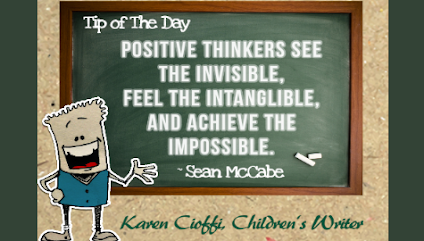
 When I was looking for a house a few of years ago, I saw this quote by Sean McCabe, and it amazed me how accurate it is.

As my husband and I were looking, my husband saw all the things wrong with each house. It had wall paper; it needed a complete renovation; it needed a kitchen; the basement needed to be finished; the rooms weren’t right. The lot was too big. It was a corner property. The list went on and on.

I saw all the things right with each house. I saw how it could be. I have the ability to look beyond what’s actually there (see the invisible and feel the intangible) and see what can be.

It made me think about writing. Most writers understand that writing can be a tough business. There are lots of rejections and lots of ups and downs. To survive in this business, you need to keep a positive mindset. You need to persevere. You need to see beyond the slumps. You need to keep moving forward and achieve what may seem impossible.

This also goes for those who want to be an author but have no clue how to go about doing it. Seeing things through a positive mindset allows you to figure out what to do, whether it means hiring a ghostwriter or taking the steps necessary to learn to write yourself.

But it goes beyond writing. As with everything in life, there will be obstacles in your path. Sometimes those obstacles may seem insurmountable. The key is to not let them stop you. Keep moving forward. You might even envision yourself happily beyond the problem or obstacle.

So, whether it’s with your writing life or life itself, be a positive thinker.

See the invisible and the intangible and achieve the impossible.

ABOUT THE AUTHOR

Karen Cioffi is an award-winning children’s author and children’s ghostwriter, rewriter, and coach with clients worldwide. She is also the founder and editor-in-chief of Writers on the Move and an author online platform instructor with WOW! Women on Writing.

Karen’s children’s books include Walking Through Walls and The Case of the Stranded Bear. She also has a DIY book, How to Write Children’s Fiction Books. You can check all her books: https://karencioffiwritingforchildren.com/karens-books/. If you need help with your children’s story, visit: https://karencioffiwritingforchildren.com.
 

Sunday, March 6, 2022

Queries - Be Specific and Professional


By Karen Cioffi

All writers face the dreaded query. Did I put enough information? Did I put too much? Did I have a great hook? Am I submitting to the right publisher?

These are just a few questions that run through a writer’s mind when mailing, or clicking the send button for the query. So, how do you answer these questions and the many others that go along with the job of crafting a query?

Well, the first simple response to this question is to READ the publisher’s or agent’s guidelines. Okay, that’s not accurate-you need to STUDY and FOLLOW those guidelines precisely.

Items to watch for when reading those guidelines:

1. What genre does that particular publishing house, agent, or magazine publish?

2. Does the publisher/agent accept simultaneous submissions?

3. Is there a specific word count involved if querying for articles?

4. Does the publishing house accept unagented queries?

5. Does the magazine only accept specific themes, if so, is your article on target?

This list is not complete, there are obviously more items to watch out for. So, we go back to the main rule for querying: FOLLOW the GUIDELINES!

But, following the guidelines is just part of the querying process; you also need to know some inclusion essentials.

Six rules to use that will help you create a winning query:

1. Be professional. Writing is a business just like any other-treat it as such.

2. Be sure to include your contact information: address, telephone number, email address and website.

3. If you were referred by someone include it in the query. Every little bit helps, but be sure it’s a referral from someone the editor actually knows.

4. Write tight – be specific and jump right in. You want to provide enough information to warrant the editor to want more, but you need to keep it to one page.

5. The first paragraph is the pitch-within a couple of sentences you need to hook the editor or agent. The second paragraph is about you, again keep it brief and include your credentials. The third paragraph is your conclusion; thank the editor/agent for his/her time and mention if you are enclosing a SASE and if the query is a simultaneous submission.

6. In regard to your bio: Limit personal information unless it adds to your credentials as a writer qualified to write for this publisher.

A good way to practice for queries and pitches is to write a one sentence out of the ball park description of your manuscript. This will help you to think and write tight and choose the perfect words to hook the reader and convey the essence of your story.

ABOUT THE AUTHOR

Karen Cioffi is an award-winning children’s author and children’s ghostwriter, rewriter, and coach, with clients worldwide. She is also the founder and editor-in-chief of Writers on the Move, and an author online platform instructor with WOW! Women on Writing.

Karen’s children’s books include “Walking Through Walls” and “The Case of the Stranded Bear.” She also has a DIY book, “How to Write Children’s Fiction Books.” You can check them out at: https://karencioffiwritingforchildren.com/karens-books/. If you need help with your children’s story, visit: https://karencioffiwritingforchildren.com. 

Monday, February 28, 2022

Benefiting from Writing Conferences


Networking is a part of benefiting from a conference


         Writing is a profession, and attending writing conferences and festivals are a necessary part of staying professional. Conferences allow a writer to gain new ideas to improve his work, to reinforce good writing practices, and to learn other aspects needed for his writing business. Networking allows writers to know they are not alone in the wilderness. So, how can writers benefit from writing conferences?

         Best selling author William Bernhardt gives a few ways an author can benefit from a writing conference:
 1. Come prepared. Research speakers to know what they offer that will help you. Research editors and agents to know which will provide insight into what you write or who want what you write.
 2. Listen more than you talk. "...a person gets a few minutes alone with someone who might have some good advice for them, but they use the entire time to talk about themselves or their project." Bill continues, "My advice has always been to go for the 20/80 talk rule...talk being the twenty percent."
 3. Relax and learn. "The best favor you can do for yourself is come with the expectation of learning not selling. If you're able to absorb the information, you're going to be a better and better writer. The time will come when you'll find yourself in front of the right people at the right time. And because you've been educating yourself, you'll be ready.

         Attending conferences to learn should be the first objective for attending a conference. I don't always learn something every session I attend, but, even though I taught writing for nearly 30 years, I always learn something that helps my writing improve every conference I attend.

         If you have completed a manuscript, attend a conference prepared to pitch to an editor or agent. That means you learn how to make a pitch, prepare your pitch, and practice your pitch before the conference.

         Listen to those who have been in this business for years. Gain from their experiences. Will everything you hear work for you? No, but at least you can learn what to try. If something works, you gain. If it doesn't work, you also gain the knowledge that idea won't work for you. We are made with two ears and one mouth for a reason. We need to listen more than talk.

         Absorb what you hear and see. I retain more if I write it down than if I just hear it. Therefore, I take notes so that what I hear is absorbed into my mind.

         One of the biggest reasons I attend conferences any more is to meet and greet other authors, to network with writers and publishing gurus. I become more energized and recharged after attending a conference and networking with others in the same business.

          As Bill Bernhardt says, "Go to learn. Prepare to pitch. Listen. Absorb. Meet and greet." Conferences are needed to build a writer's professionalism.


Tuesday, February 22, 2022

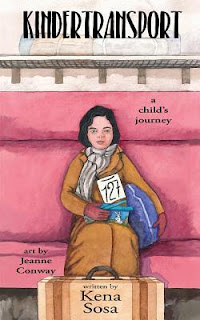
Review: Kindertransport by Kena Sosa


Kindertransport 
by Kena Sosa, illustrated by Jeanne Conway
Review by Cheryl C. Malandrinos

Kindertransport by Kena Sosa is the touching story of a young Jewish girl in Germany who gets onboard the Kindertransport train headed for England.

In the days before the outbreak of World War II, Helen finds herself trapped inside her house. Unable to understand why her family’s life has changed so suddenly, she worries as Vater’s mood changes and Mutter pretends she doesn’t like eggs simply so Helen will have enough to eat. Then one day, Mutter tells her to pack her suitcase so she can ride a train that will bring her to England until the danger is over.

Sosa has done a fabulous job of bringing to life the experiences of so many Jewish children in the days before the war started. She captures the emotions, the frustrations, the uncertainty Helen feels as life has changed. I’m sure the interviews she conducted with Jewish survivors helped flesh out the details, and it is that research that allowed her to create such an incredible story. An afterword shares more about Kindertransport, and a list of materials used in the research for the book is included.

Accompanying Sosa’s moving text are the black and white illustrations by Jeanne Conway. The burning of Vater’s bookstore, how Helen clings to her bunny as she packs, and the hope Helen feels as she holds on to the ship’s railing on her way to England are all brought to life by Conway. 

Kindertransport might be one of the most stirring books I read this year. I highly recommend it to readers everywhere.


Kindertransport and other books by Kena Sosa are available at https://www.4rvpublishing.com/kena-sosa.html and other online retailers. 

Tuesday, February 8, 2022

When the Creative Stream Stops Flowing


        I don't actually have writer's block, but I may have a problem with a transition from one scene to another or knowing how to develop an idea. Looking at a blank page doesn't scare or worry me. Not finding the right words does.

        So, what does a person do who isn't able to continue or to start writing? Allow me to share a few ideas. 

        Often people complain they have writer’s block. They stare at a page, whether paper or computer, and nothing comes. Their brain matches the page – blank. I never had that drastic a problem because my mind keeps working but perhaps can’t find just the right words, can’t get that just right description, or can’t decide how to create a word bridge between scenes. So, all authors need ways to turn those creative ice blocks back to a full stream again. First, we need to consider the reasons for any block before we look at ways to overcome the problem.

         Jeff Goins lists the main reasons he discovered for the creative stream stopping:

• Timing: It’s simply not the right time to write. Your ideas may need to stew a little longer before writing them down.
• Fear: Many writers struggle with being afraid, with putting their ideas (and themselves) out there for everyone to see and critique. Fear is a major reason some writers never become writers.
• Perfectionism: You want everything to be just right before you ever put pen to paper or touch a keyboard. You try to get it perfect in your head and never do, so you never begin.

         Although, Goins wrote about blogging, writing is writing. Most ideas cross between all types of writing to a certain extent.

         Goins also gives suggestions of what not to do to try to overcome writer’s block:

• You do not overcome writer’s block by refusing to write until you feel “inspired.”
• You do not overcome writer’s block by wallowing in self-pity.
• You do not overcome writer’s block by procrastinating or making excuses.
• You do not overcome writer’s block by watching TV.
• You do not overcome writer’s block by reading articles on how to overcome writer’s block.

         Now, let’s discuss some ways to restart the creative stream. Both Goins and Pete Croatto suggestion moving away from the situation. Croatto says to change location to find inspiration. Goins says to go for a walk. One way I can restart the process is to work on something else for a short period of time. When I return to the first project, my mind has worked out the problem whether it is a needed transition or an idea that needed development.

          By removing ourselves from the “blank” page, our minds can be sidetracked from the problem and have an opportunity to find stimulation or inspiration. 


Sources:
Croatto, Pete, “Parallel work,” The Writer, May 2018, page 10.
Goins, Jeff, “How to Overcome Writer’s Block: 14 Tricks that Work,” https://goinswriter.com/how-to-overcome-writers-block/
Zabel, Vivian, experience and methods from the teaching