Tuesday, July 12, 2011

Preparation process: getting ready to print

by Vivian Zabel 

          Most writers and illustrators know that a manuscript is edited, formatted, proofread, designed, copy-edited, and approved by the author and, if illustrated, by the illustrator. They know that they need to have all errors corrected and all revisions made before a final approval is given.

          Then why do so many want to add something or change something after the final approval? A message stating, "Since this hasn't been sent to the printer yet, please change my name to XYZ," or "I want to add a dedication. I realize I should have done this earlier, but ..." is not a message any designer or editor or publisher wants to receive. Each person seems to think his or her manuscript/book is the only one the designer or publisher has on the schedule, that anything else can wait until this person's additions or changes are made. Never mind that the staff has moved the files to the printer and begun working on the next item.

          So, what is the process leading to a book being print? Let's look at what happens.

1. The manuscript is accepted and a contract offered.
2. An editor is assigned, and editor and author work as a team to make the manuscript the best it can be. If an illustrated book, illustrations are finished.
3. The manuscript is proofed by the head of the editorial department or other editorial staff.
4. The designer formats the manuscript, including cover, illustrations if any, dedications, acknowledgements, author bio (and illustrator bio, if illustrated), and all other components.
5. A PDF proof is sent to the author and illustrator, if there is one.
6. Author and designer copy edit the PDF/proof.
7. After all corrections and revisions, a final PDF proof is sent to the author for a final approval.
8. Designer then prepares a distilled PDF of the interior and of the cover, which is sent to the person who uploads files to the printer. In the case of 4RV Publishing, that is the publisher.
9. After the approval by the author (who should have examined the proof PDFs very carefully before approving), changing anything is too late and is costly. 
10. IF an author decides changes are needed after the files go to the printer, the author must pay for time involved and fees to the printer.

          After files are sent by the designer to the person who uploads them to printer, the designer begins working on the next item or items on his/her schedule. Any changes to a project passed on results in the designer having to neglect someone else's project, disrupting a schedule already filled.

          Therefore, a note to writers: Be sure you send any wanted dedications, acknowledgments, short bio, and photo to the head of the art department and publisher at the beginning of the editing process. Illustrators need to send their short bio and photo in early in the process, also.

          Let's all work together without creating problems along the way, problems that can be avoided with a bit of forethought.


4RV Catalog


Monday, July 11, 2011

Nothing New Under the Sun, But Writers Make It So

by Holly Jahangiri


I was telling someone about a story I recently wrote. "So, basically, it's 'The Little Boy Who Cried Wolf'?"

"Well, yes, actually - except that there's no wolf." A minor technicality. Ever feel like, no matter what you write, it's all been written before? Do you find that discouraging?

Did you know that there are some 27,000 variations on the Cinderella story?

Years ago, while lying on a concrete floor in the basement of the University of Tulsa's library, reading what I should've been reshelving, I ran across a book called The Thirty-Six Dramatic Situations by Georges Polti. I was fascinated by the notion that every story could be pigeonholed into one of thirty-six basic plots. Polti even suggests the necessary characters to pull it off; for example, in a storyline he calls "Rivalry of kin," we have the Preferred Kinsman; the Rejected Kinsman; and the Object of Rivalry. Sounds like the The Prodigal Son, doesn't it?

Since then, I've read there are only twenty - or, to simplify matters even further - seven. They can be summed up as follows:
[wo]man vs. nature
[wo]man vs. man
[wo]man vs. the environment
[wo]man vs. machines/technology
[wo]man vs. the supernatural
[wo]man vs. self
[wo]man vs. god/religion

I suppose you could combine them further and say that really, there are only four:
[wo]man vs. nature/the environment
[wo]man vs. man/machines/technology
[wo]man vs. self
[wo]man vs. god/religion/the supernatural

I'm tempted to say "three," but to combine "self" and "man" might be pushing a point. Besides, if you're looking for story ideas, Polti's thirty-six provide more food for thought.

Some years ago, I wrote a story called "Just a Little Peace and Quiet." After rereading it, I realized I'd written a modern, feminist version of Edgar Allan Poe's "Cask of Amontillado," With a wicked little twist all its own.

If we shut down and gave up every time we wrote something that's been "done before," we'd never write another word. For grins, read Cecil Adams' take on the whole notion at "What are the seven basic literary plots?"

One intriguing aspect of Polti's thirty-six dramatic situations is the notion that there are 36 emotions (I can run through half of them in two hours, if the movie is any good).

In exploring the basic plots and story structure, it is impossible not to stumble across folkloristics - the study of motifs in folklore. A motif is a recurring element having symbolic significance. It is not an ordinary, everyday thing or occurrence. A flying carpet, for example, is a motif. A mother is not a motif, but a cruel or murderous mother is. Transformation of people into animals or objects may also be a motif.

The trick, then, is to travel the well-worn trail, but to make it uniquely our own.

Just for Fun and Practice

  • Choose five of your favorite books. Identify the basic plots each book fits into best.
  • Write a short story (about 500-1500 words) using one of the basic plots identified above (or one of the thirty-six described by Polti)
  • Post your response on your own blog - be sure to label it with the chosen plot or dramatic situation and leave a link in the comments here.

Do you think that recurring symbolism (use of motifs) is an effective storytelling device? Why or why not? Why do you think this features so prominently in folklore?

Friday, July 8, 2011

Is illustrating a poem or story different than a book cover? Yes & No ...

by Aidana WillowRaven

I belong to various artist networks that, at times, amaze me with the artists' skill & craftsmanship. What's unfortunate, being an Art Director who's always looking for fresh, undiscovered illustrators and cover artists, I rarely find work that convinces me the artist knows what is needed for a good book cover. Sure, many of the works I see are gorgeous, and would make a great wall hanging. Many would be perfect for complimenting a magazine's story or a book's poem, but when I am looking for a potential cover artist, I am not looking for someone I need to coach about bleed, gutter, or negative space for back cover blurb, spinal text, title and byline.

I'm not saying EVERY piece you do has to be cover art ready. After all, it takes a different approach to space and composition, and sometimes as artists, we're just not feelin' it. I get that. But I am saying, if you want to get into the cover art business, the AD has to see that your work could be used for a book's cover without too much extra attention needed by a designer to make it usable. Time is money. And at a standard $45/hour rate, let's show the PH we can save them some money by showing we can create cover art as well as stand alone art. Publishers like it when we save them money ... lol.

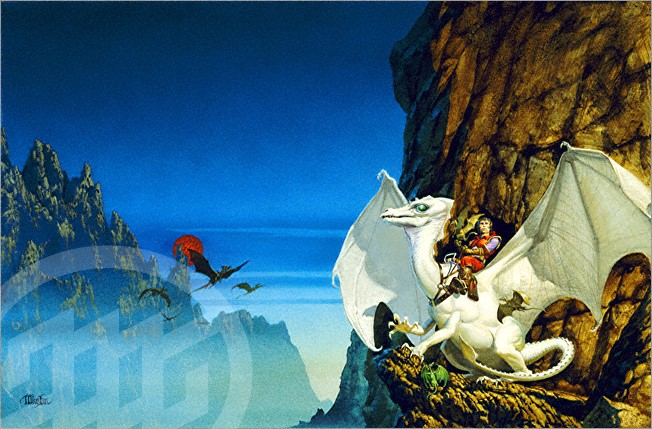
Early in my fine art studies, knowing my eventual goal was to become a fantasy book cover artist, I not only studied the masters (DaVinci, Michelangelo, Renoir, Dali, etc), I also studied fantasy book cover legends, like Micheal Whelan (Dragon Riders of Pern cover artist, among others). He published a couple books containing interviews with various authors he graced covers for over the years. He also shows sketches, and offers commentary, on some of his more popular works that helped turn those books into bestsellers. I still study them when I need inspiration.

If I try to emulate him in any way (since I can't touch him artistically ... lol), it's in his use of composition. I'm paraphrasing a bit, but he states how he tries, while catering to the dimensions and needs for a book's front cover or cover wrap (jacket or paperback potentials), he deliberately sets it in his mind to make the piece stand alone, too. To create a piece of art that just 'happens' to double as an excellent book cover. Well, that 'happens' is no accident. That means a lot of planning goes into composition long before any final painting is done. You can probably guess, that this piece is for a front cover. See the room he gave for title and byline, along with trim room for the printer? Yet, he still follows the laws of a great composition. Those 'negative spaces' are not void of interesting material, they're just non-essential elements - elements that if hidden by text wouldn't affect the main subject in the scene, and will not obstruct good titling. As a matter of fact, I can't be 'certain' this one was a book cover. But if it wasn't, it would surely show an AD that he was fully capable of accommodating one. Wouldn't it?

Now, if you look at the piece to the left, or the White Dragon piece above, it's apparent these would make awesome cover wraps. The central focus is on the right (ideal for front cover use), while the central and left areas, though never lacking in interest or beauty, are obviously not the focus, and would accommodate a spine and back cover info, perfectly.

Notice, again, plenty of room for title, spine and by line.

Now for testing one's own work against a master cover artist. Remember, we are looking at my composition, not comparing my painting ability against Whelan's ... lol (I'm no fool).

Not too long ago, Vivian shared one of her poems with me, and it got my mind a buzzing, This would make an awesome art piece! So I bullied her into letting me illustrate not only that poem, but a gaggle of others similar in mood. Like my unbeknownst mentor, I tried to look at the composition as a cover piece. You never know, she may want to publish the poems and use this work as the cover. So I planned ahead, and set to work.

When Death Sat Next To Me

When Death sat next to me,
I thought she looked familiar.
I asked, "Have we met?"
Elegant and attractive in black,
she offered a sad smile,
her luscious lips glossed in red
tilted slightly at the edges.
"Oh, yes, I've walked many
a long mile by your side."


If you click the image, you can zoom in and get a closer look.
First, I created the main character, Death. The poem describes the hair clearly, so I decided on a sleek dress with dramatic drapery and folds. Something elegant and eternal, out of current fashion, but still glamorous. Frayed at the bottom from eons of dragging the ground, yet silky and flowing. And of course, the scythe was a must. It's Death's calling card, even though the poem never mentions it. In a later post, I'll go into more detail as to why I chose the elements that I did.

My biggest decision was her placement in the scene. I needed her facing the audience, and the 'victim' while encouraging them to maybe open that potential book to see what's inside. Her pose had to not only be sitting, but be graceful, elegant, dark, and alluring. 

While accommodating the details of the poem (this is only the first stanza), I still had to remember to leave negative space for tile and by line, if ever needed. At the same time, I want to make sure if they are not there, that the piece could stand alone, and not feel lacking, in a frame or on canvas. In this instance, the subject matter called for a haze, a sort of obscurity, like the person meeting  Death face to face, notices nothing but her and the grave. This also wasn't spelled out in the poem, but it just 'felt' that way.

Why don't you judge? Look to see if my composition would not only make a believable stand alone piece for a magazine, poem, or frame, but also a potential book cover?

  • Title room: check
  • By line room: check
  • Bleed/ Trim room: check
  • Main elements unaffected by the above needs: check

So how did I score? 

Maybe next time you are planning a composition, with the idea of attracting a publisher or Art Director, you'll compose it as a potential book cover? And maybe, just maybe, your next commission will be as a cover artist.


Aidana WillowRaven


Art Director & VP of Operations
4RV Publishing

Thursday, July 7, 2011

You Finished Your Novel… Or Have You?

by Laurie Boris

Congratulations! You’re done with your novel. You’ve gotten feedback from your writing group or critique partner. You’ve gone through several drafts, taking their suggestions in mind, at times swearing like a trucker when characters won’t cooperate or loose ends won’t tie themselves up. You’ve burned uncountable meals, ignored many ringing phones, and put off several whining-to-be-taken-out dogs because you’ve nipped off to your writing room to “just make a couple changes.” Finally, finally, you’re ready to unleash your baby into the world.

But wait! Are you really done? Before you send the first query letter, before you pop open your celebratory beverages and start casting the film version in your head, make sure you’re ready for your close-up. Here are some “finishing touches” that can make your work stand out:

1. Cut the fat. Flabby prose can sink even a great idea, and could give readers a reason to ditch you in favor of another writer or another activity. Some common bugaboos that bug editors: too many adverbs and adjectives, excessive use of “overachieving” dialogue tags (“To the moon, Alice!” Ralph exclaimed passionately), or overuse of certain words like that or just. Do a search on your own work and see how often these often-unnecessary words appear. Yeah. I was shocked, too.

2. Got rhythm?
Are all your sentences of approximately equal length? BOR-ing! You could lull your readers into dreamland. Follow a long sentence with a short sentence, a short one with a long one. Begin a sentence with a dialogue tag, reverse it on the next. You get the drift? Mix it up.

3. Open with style.
Vary your chapter openings to keep things interesting. Begin some with dialogue. Begin some with exposition. Again, mix it up to keep reader interest.

4. Know when to walk away.
When I edit my early-stage manuscripts, invariably I find that my chapters go on a beat too long. Check the ends of your chapters. Do they compel you to read the next? Or do they contain summaries of what just happened? Go back a sentence or two to find the cliffhanger and leave us dangling there.

5. Format for an easy reading experience.
There is a reason why agents, proofreaders, editors, and publishers ask you to format your manuscript in certain ways. Because they read manuscripts for hours on end. They’re all human, with human brains and mostly, eyes that are no longer twenty years old. Skip the fancy fonts. Don’t cheat the margins to make your book look shorter. Double space. Put air around chapter headings and time/space breaks. If the agent or publisher in question asks for a printout, don’t create it while squeezing out the dregs of your toner cartridge. Put in a fresh one. If you’re sending photocopies, double check to make sure all pages are accounted for.

6. Pick up dropped stitches.
Have you tied up your loose ends? Perhaps you’ve dropped an early subplot or have a character hanging around with no particular purpose. I use a simple chart to help me find major plot problems. List your character's names on the left, and then across the top, make columns labeled:

What Does This Character Want?
What Does He or She Do To Make it Happen?
What Effect Does It Have?
Why Should We Care?
How Are Other Characters Involved?
Is It Resolved at the End, And How?


This has been a great way for me to keep tabs on plot lines, character development, and motivation.

7. Do I really have to mention this?
Seriously, you’d be surprised at how many typos and grammatical mistakes agents and editors find in submitted manuscripts. We’re all human. There are bound to be things you don’t catch even if you read over your manuscript a dozen times. But this is where you, the writer, can attain a greater mastery of your craft. There is no shame in hiring a proofreader or asking a trusted friend to proofread for you. Learn from them by absorbing their comments into your knowledge base. Seeing that you made the same punctuation error twenty times in one chapter is the first step toward learning how to stop doing it.

Novelists: how do you know when you’re done? Typically, how many drafts do you go through before you call it complete?

------------------
Laurie Boris is the author of The Joke's on Me, a contemporary novel due out from 4RV Publishing later this month. She also blogs about writing, books, and the language of popular culture at http://laurieboris.com.

Wednesday, July 6, 2011

Should an Author Have a Blog? Author Marketing 101

Most businesses today are using blogs as a way to promote their products and connect with their customers. So does the same hold true for you as an author hoping to market your book? Absolutely!

One of the greatest benefits of blogging as an author is that you have the ability to create a readership for your book… before it’s even released.

If you’re anticipating the release of your debut novel in a few months, you can start blogging on any topic related to your genre now. You may want to blog on how to write a children’s book as a children’s author, or even the ins and outs of the publishing process as a romance novelist. You can also use your blog for pure fiction to provide interested readers with free short stories related to your genre. Yes, it really will work.

But blogging can never reach its fullest potential if you don’t already have a presence in social media. Google views blogs as fresh content, so they’ll often rise to the top of the search results for specific keywords. But you can make it even easier for interested readers to find your blog by automatically syncing your blog to your social media profiles like Twitter and Facebook. This way, your friends and fans can read your new content and pass it around to other friends who may also be interested.

Keep Them Coming Back for More

The key to successful blogging is to use your fresh content as bait. If you’ve written an interesting blog post that has attracted reader traffic to your blog, you can’t just stop there. You need to write more and more interesting, compelling posts that will encourage readers to comment, join in the conversation, and pass links to your blog along to their friends.

In short, as an author with a blog, you are giving a valuable gift to potential readers. You are giving your readers useful content at no charge to help them put their trust in you. This is an effective and virtually free way for readers to get to know you to become part of your loyal audience. And the next time that they’re at a bookstore or browsing on Amazon, they’ll be more likely to remember your name and buy your book.


Bethany Ramos is an author and full-time freelance writer with experience in Internet marketing, social media marketing, and SEO. She is passionate about writing captivating children's books and witty chick lit. For more information, you can visit her blog at http://chicklit-books.com/.

Tuesday, July 5, 2011

RESEARCHING YOUR ILLUSTRATIONS ~ The trouble with Frogs


You, the illustrator, have been chosen to illustrate a manuscript. Your publisher thinks it fits your style.  It is a story about a magical jumping frog with some big problems. You might have some as well. Truthfully, you have never had much contact with frogs.

Now what?

For any picture book there will be an amazing amount of time spent drawing, painting, collaborating with an editor or art director.   There will also be a certain amount of research to be done.  Even a book about an imaginary frog will take time on the part of the artist to not only interpret the vision of the author, but to actually take a look at real frogs.

This can be done by observation of the real thing... photos you take, photos others provide to you and internet and periodical searches.  Even videos can help.

Did you know you can stop a video on You TUBE while you make a quick sketch of your subject?  This can be very helpful if you don't have much access to the real thing.
You may want to watch the way a real frog moves. What does it look like in and out of the water.  How does it jump.  How does it catch food.

The searching and gathering of the information is step one.  The next step is to fit the character you are drawing or painting into the specific style of the manuscript and your own artistic style.


You may need to provide extremely detailed and realistic illustrations.  On the other hand you may need to be quite whimsical in the approach to the character.   This is true not only for frogs as noted in this example, but for all the characters.  Humans, animals, and anthropomorphic animals need to have one thing in common in a picture book:  "Character."

The above illustration was used for T shirt design 

Even Lizards can be comical or whimsical and still be based upon the actual observation, photos or videos of lizards.


How do you arrive at the essence of your character?  Partly through the manuscript.  Partly through your own talent and experience and partly with the aid of the editor or art director's comments.

Finding the right tone for an illustration will depend upon the tone of the text.  An illustrator will do the best job for a client when the illustrator has a good grasp of the manuscript and has read it over a number of times.  The effect can be different with each reading.  Some facts that jump out at first may become less important if another aspect of the story seems to be more important for the reader to "see."  This can also mean not using an illustration and substituting it with another. An illustrator needs to be willing to give up some images just as a writer needs to be willing to give up extra words.

Getting from "here to there" in an illustration takes time and study.  It means preliminary work before you jump feet first into the water.  The work an illustrator does to perfect a character before creating pages and pages of that character is an important part of the journey.  The big PLUS is that it may not only make the work more enjoyable but create an opportunity to develop a character that is also quite memorable!

My best advice to any illustrator is to always have a camera with you as well as a sketchbook.  If you are lucky enough to see something unusual, interesting, or something that actually pertains to the work you are doing at the time, you will have the tools you need to record the moment.  You never know when an opportunity for a great resource will pop up right in front of you.


Monday, July 4, 2011

SEO and Marketing: Basic Tips and Definitions

In its simplest form, promotion is a tool or strategy under the marketing umbrella. The marketing umbrella covers the creation or manufacturing of a product or service, R&D, distribution, and any other elements needed to get a product from creation to the consumer. Promotion creates visibility.

Utilizing online promotion means you will be using the internet, search engines, and SEO. SEO is the process of getting the search engines to find and rank your content. You obviously want a high ranking so when a searcher (potential customer) types in a search term (keyword) your site may be one of those on that first SERP.

Marketing and especially SEO can be confusing and seem like a daunting task to undertake, but once you understand the basics it becomes less intimidating.

SEO and Marketing Definitions

1. SEO – search engine optimization: “the process of creating and adjusting website content with the goal of improving search engine rankings.” (according to Compendium.com)

2. SERP – search engine results page – the page results from a search query.

3. Keyword – “any word or phrase a searcher might use to describe or identify a desired resource on the Internet.” When using keyword in your title, it’s important to use the keyword in the beginning of the title. Rather than use “How-to-Guide for SEO,” opt for “SEO: A How-to-Guide.” (according to Compendium.com)

4. Organic Traffic or Marketing – free strategies, such as Twitter, blogging, article marketing, etc.

5. Paid Traffic or Marketing – utilizing paid/sponsored ads, such as Google adwords, etc.

6. Ranking – your position (how high up) on the SERP: the higher the better. In other words, you want to be on the first SERP, or at least within the first few pages.

7. Anchor text – linking to other websites and/or pages directly from text within your content. This strategy should be used to bring the reader to your products, to other related articles you’ve written, to another site that has useful information pertinent to your post, and/or to link to a site you’re mentioning.

Providing readily accessible information and links through anchor text will give your readers more “bang-for-the-buck.” It will give the reader a broader reading experience, and she will definitely appreciate it – this builds a relationship . . . and trust.

Using anchor text links will also help search engines, such as Google and Bing, relate your content to other relevant content, and create a target for searchers to hit.

One last note about SEO, keep your keywords simple and concise. And, often it’s of greater benefit to use long-tail keywords. These keywords may not get as many search hits, but they do get a much more targeted audience; this leaves you with less competition.

An example of a keyword might be, “allergy relief.” Allergy relief is a very generic and heavily used keyword. In order to make it more specific and hone in on a narrower audience/searcher, you might use, “allergy air cleaners,” or maybe, “remedies for allergies,” or, “allergy sinus medications.” You want to narrow the playing field.

There are free tools to test out and analyze keywords; here are three of them you might try:

http://freekeywords.wordtracker.com/
http://www.keyworddiscovery.com/search.html
http://www.wordstream.com/keywords/ 

~~~~~~
My middle grade fantasy book Walking Through Walls will be available for sale beginning the middle of this month. To read a number of reviews please visit:

http://walkingthroughwalls-kcioffi.blogspot.com/p/walking-through-walls-reviews.html

You can pre-order get your copy of Walking Through Walls today at:
http://4rvpublishingcatalog.yolasite.com/mg-ya-page-2.php
 
And, check out the amazing book trailer Aidana WillowRaven created for the book:
http://youtu.be/90aJO5qHHWc

Karen Cioffi is an author, ghostwriter, and freelance writer. For writing and marketing information visit http://karencioffiwritingandmarketing.com and sign up for her free newsletter, A Writer’s World - you’ll get 2 free e-books on writing and marketing in the process, and two more free e-books just for stopping by.