Tuesday, October 25, 2011

The "head count"


As an illustrator one may be asked to create a number of figures for any book assigned.  In my case I needed some accurate heights for an entire range of people from infants to adults.  Using the basic scientific ratios for number of heads high an individual is, I created my own "head count" chart.

For me it was easier to use the heads on characters I had created to make sure the sizes matched correctly.  The chart above is for a realistic view of the figure.  For other more cartoony styles the head count here will not match. I do find it helpful enough to keep it on my bulletin board next to my desk *:)

The chart above is very helpful when I have a question about height and have no model to use as a reference.  Of course these characters are all standing but you can apply some of the rules to sitting or active figures with a bit of adjusting.

If you are an illustrator with a need for such a chart, please feel free to download and keep this on as a reference.  You could make your own by using your character style and just the numbers posted above each character on this chart.

Friday, October 21, 2011

Promotion: Two Festivals with the James Writers

by Vivian Zabel  

          Mother and daughter authors Jean and Mary James took their new release Sparrow Alone on the Housetop, copies of Mary's music projects, and copies of other 4RV books on the road. 

          The first book festival they manned (uh, womanned?) a booth was the Baltimore festival. There they met -- gallons of rain, rain, and more rain. Note the river flowing through the tent in the photo below:
Booth without showing river


          Then the James duo packed up books and headed for Nashville and the Southern Festival of Books.

One display with other books out of view


             Next, Jean and Mary will be packing books and heading for the Miami International Book Fair. Now these writers have gone above and beyond the call of duty. If you visit the website, vendors and exhibitors, 4RV Publishing is listed under the General category.

            We hope you sell many books, James Writers, at this last of the trio of festivals. Thank you for your hard work and efforts.


4RV Bookstore   - Remember the Holiday sale until December 5
4RV Website 

Tuesday, October 18, 2011

Do It and the Energy Will Come

"Do It and the Energy Will Come" by Joan Y. Edwards

Ralph Waldo Emerson said, “Do the Thing and You’ll Get the Energy to Do the Thing.” To me his words translated into, “Do It and the Energy Will Come.” It was one of those “Wow” moments for me. I asked myself, “Is that true?” You might ask yourself the same question.

Remember the times your baby woke you up in the middle of the night. Somehow getting up and seeing to it that they were all right, gave you energy to complete that task before you went back to sleep.

What about the time you didn’t want to do the dishes, but you started on them. Pretty soon, the dishes were done, and your energy level had sparked.

What about working on your term papers the last few hours before they were due, you all of a sudden had the energy to do it. Why? At the time you may not have known. But you knew you had to get it done now or it wasn’t going to be done at all. Plus, each step you took gave you energy to do the next step, until you had the whole paper finished.

What about when you want to read a book on the craft of writing or a book on how to draw action figures, but you’re not in the mood. Start reading it and you’ll get in the mood. The energy will flow.

As a writer or illustrator, have you been saying, "I don't have the energy to do that." Try knocking down that excuse. Work on the article. Sketch that picture. Watch the energy flow to your mind and body.

Action is a mood buster. Test this theory for yourself. Accomplishment gives a great feeling of satisfaction. It makes the next step easier. Finishing three small things will give you energy to start a bigger project.

Empower yourself. Do it and the energy will come.

Wednesday, October 12, 2011

Promotion: Eastern Oklahoma Author Fest 2011

by Vivian Zabel 


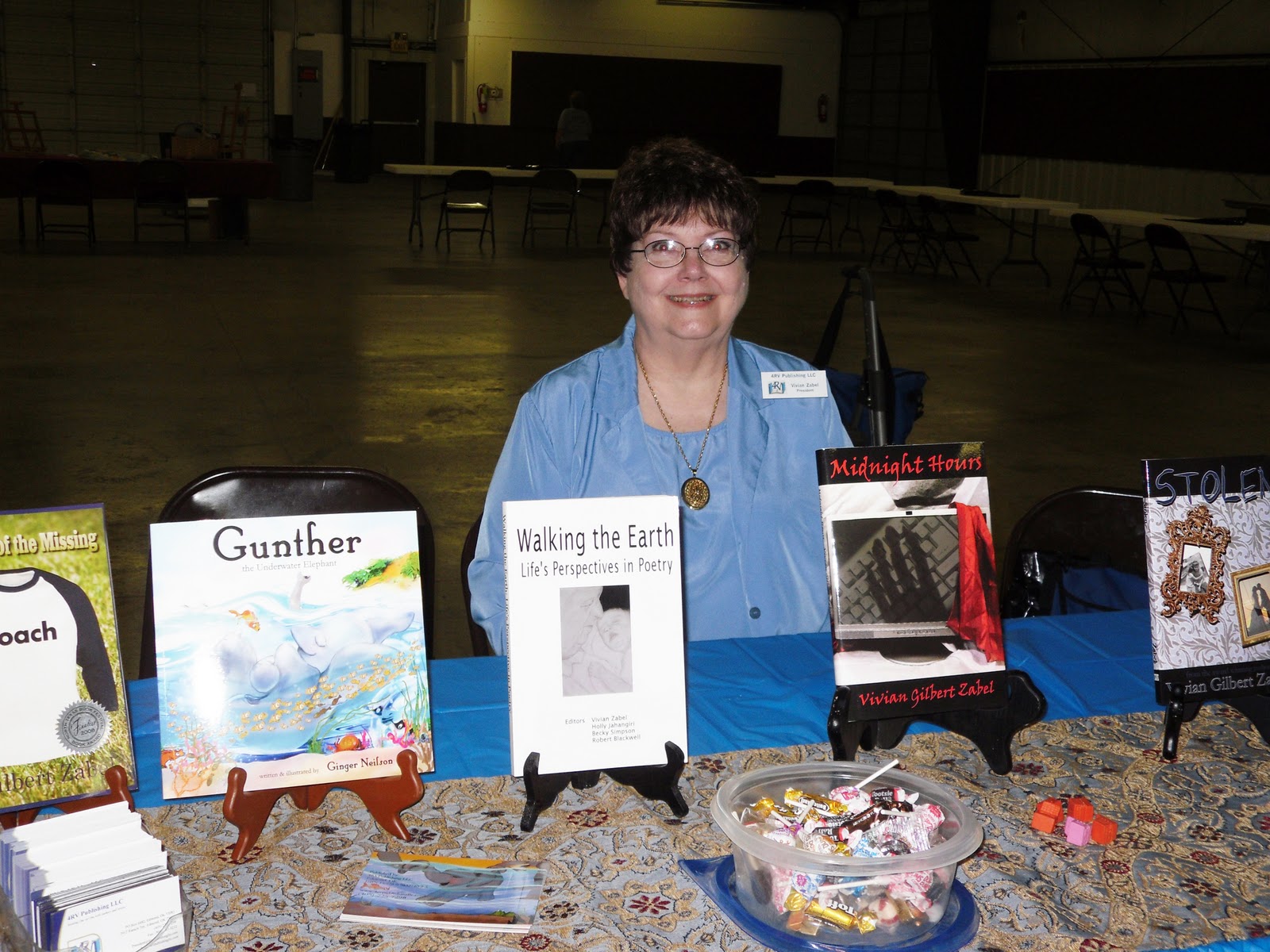
         October 8, 2011 found 4RV Publishing and three members with 43 titles at the Eastern Oklahoma Author Fest in Tahlequah, Oklahoma.

        Due to the massive weight and hard work involved (as well as limited display area and racks), only 43 of the 60+ released books were able to make the trip.

         As people entered the Cherokee Community Building, the sign to the left is the first thing they saw. The display tables formed an L, one table to the right of the sign, one to the left, and one running at a right angle down the left side. Photos show the display racks and display areas.


        Vivian Zabel held a workshop on "Make Your Writing Snap" to help attendees have a better idea of what manuscripts need to be appealing to editors, agents, and/or publishers.  At least some people attended, even though the workshop was early in the day, soon after the doors opened to the public.


      Jacque Graham had the workshop immediately after, "How to Write Your Family Story." Again, some attended even though early in the day.

          Jim Laughter's first children's book, and first book with 4RV, made its debut at the festival. Strangers in the Stable also sold more copies than any other book available. 


          The attendance was lighter this year than at this same festival in 2010, but 4RV did much better than most of the participants.


Table running down left side

Front tables with Jacque in background


          These photos give an idea of how the 4RV Publishing tables and displays greeted the public as they toured the festival. 

          Even though many other activities competed for people Saturday, some found their way to the Eastern Oklahoma Author Festival.

4RV Bookstore 
    Note: Christmas sale (over 10% discount on all prices, which includes shipping, handling, & taxes)
               Sale ends Dec. 5
4RV Website

Tuesday, October 11, 2011

The illustrator's obligation to the author.

by Ginger Nielson

A Picture Book is the world in your lap.  It can be an art gallery within 32 pages.  But it is more than that. It is the love and labor of an author. The words may be few or many but the combination of words and pictures must fit the story.

For example: This page from Caelaach McKinna's book, Little Charley Thornpaws, contains few words.  The illustration has been given the job of defining the action. With only one line of text, the illustrator was given an entire two page spread to show the action.  Ample space above the running cat was left for that one line.

Some chapter books require much more space for text and very little room for illustrations.
Here the illustrator is challenged to create a meaningful image in a much smaller space and often in black and white.

The many words in a chapter book are important to the author and they need their space along with any illustrations that accompany them. Some illustrations may run along the side of a page or be located only in the top third of the page. Those are normally in black and white but could be color.

In some cases there may be so much text per page that the illustrator needs to use space creatively and sparingly.  In the case in a chapter book where only a small portion of a page can be used for an illustration the image need not be more than one single item of importance.


Suspense, mystery, humor, delight, beauty, power, danger, glee and even plain foolishness find their way into an artist's interpretation of the story. But all those emotions are the property of the author first.

An illustrator needs to show respect for the author, the author's vision and the need the author has to create their own world of characters, places, things, adventures.

Painting a two page spread with little regard for the importance of the author's words can lead to a page so filled with images there is little room for text.  It may seem like the most basic of rules; the illustrator must leave room for the text.

In addition to the importance of space for the author's words, the illustrator also needs to think of the reader. Leaving room for the text that accompanies an illustration is important.  Leaving some "resting space for the reader" is equally important.  Not every inch of the page needs paint.  White space creates a place for text as well as a rest for the eye of the beholder.
This "resting" space need not be white, but it should be a clam area with not much going on to be defined as true "resting" space.


A well balanced picture book will have illustrations that compliment the author's vision and enough areas of white space or "resting" areas to allow the reader the most enjoyable experience.

The job of the illustrator is to interpret the author's vision, show respect for the words that have been so carefully chosen, and contribute to the journey a reader is about to begin.


Sunday, October 9, 2011

Storytelling – Keep Your Reader Engaged

As an author it’s your job to create an engaging, compelling, suspenseful, intriguing, romantic, or other type of story content that will lure readers in and keep them turning the pages. But the key word for a successful story is ‘engaging.’

Engagement, according to Merriman-Webster.com, means to have an emotional involvement or commitment. Based on this, no matter what genre you write in the story must hold or engage the reader.

In an article in the Writer’s Digest January 2011 issue, Steven James takes a look at aspects of great storytelling.

The first rule to a successful story, according to James, is “cause and effect.” In children’s writing this is the same as an obstacle and its solution - there must be a circumstance that leads the protagonist to an action in an effort to find a solution. I do like the “cause and effect” wording James uses though, because it’s more in line with multiple writing genres.

In its simplest form, something happens (the cause) that creates or motivates an action or reaction (the effect).

James goes on to explain that along with cause and effect, the order in which an event unfolds or how it’s written will also make a difference between keeping a reader engaged and allowing for disengagement.

“As a fiction writer, you want your reader to always be emotionally present in the story,” explains James. If the sequence of an event causes the reader to stop and wonder why something is happening, even if just for a moment, disengagement grabs the reader.

As an example, suppose you write:

She fell to her knees, dropped her head, and wept uncontrollably. Her husband was dead.

While after just eleven words, the reader learns why the woman is crying, it may be enough time for that reader to pause and wonder why the character ‘fell to her knees, dropped her head, and wept uncontrollably.’ Creating the ‘effect’ before the ‘cause’ can lead to disengagement.

To create a cause and effect scenario that keeps the reader in the loop, you might write:

“Your husband is dead.” The words echoed through the room. She fell to her knees, dropped her head, and wept uncontrollably.
A second aspect of writing James touches upon is creating and maintaining a believable story. Even if writing a fantasy or science fiction, consistency is needed, along with believable actions, reactions, observations, conclusions, and so on, within the boundaries of the story.

A basic example of this might be if you write about a character with brown eyes, then somewhere within the story you accidently mention the eyes are green. This little slip creates a believability gap.

Any gap in the believability of the story or its characters has the potential to cause the reader to pause, question, and very possibly become disengaged.

~~~~~~~~~~~~
For writing and marketing information visit http://karencioffiwritingandmarketing.com and sign up for her free newsletter, A Writer’s World. You’ll get 2 free e-books on writing and marketing in the process, and two more just for stopping by.

Thursday, October 6, 2011

Promotion: How Do You Present Your Book?

by Vivian Zabel  

          When you submit a press release, are interviewed, or blog about your book or books, do you present yourself as self-published, as published through an independent publisher (one who charges authors), or as published through a traditional publisher? Wording can make a difference in how readers or listeners perceive the source of your publication.

           Often newspapers change the way the author (agent or publisher) present material and omit the publisher if there is one. Therefore, we need to be sure that information is given in different places and ways so that readers know a publisher is involved. If one is self-published or not, even if not stated, the lack of the name of a publisher makes it appear that the book being promoted is self-published.

          If the article, blog post, or interview states "Mercy Jones published Shame, Shame," the inference is Mercy Jones self-published the book. If the only link is to the author's website or the only places listed for the book to be purchased is the author's website and/or Amazon, the reader will assume the book is self-published.

          Yes, more and more people are self-publishing, which is the topic of a completely different article. However, if a person used a publisher, and the publisher has taken a risk of preparing and printing the book, then it's only good manners and another promotional tool to give credit to the publisher.

          How do you present your book? Do you present it as a professionally published book? Do you present it as self-published when it's not? Do you present it as a product that you and only you produced? Do you present it in a way to show that it and you are professional? Do you promote it, and yourself, with credit to those who helped make the book possible? Do you share that the book can be purchased through bookstores (if it can be), as well as through your website and Amazon?

          Give you and your book every opportunity to attract readers by allowing them to know more about your book. Present it well.

4RV Website 
4RV Bookstore