by Jacque Graham
“Variety is the spice of [a writer’s] life.” Face it, Muse cajoles us with a new idea, or forces us out of bed at three o’clock in the morning demanding we write that passage or poem bouncing around our brain. So now it stares at us from the computer screen or from the yellow pages of a legal pad. What now? The work begins.
Editing is a mandate. We are reminded by our fellow writers to “Show don’t tell.” So we check our manuscript for errors in punctuation, capitalization, and spelling. We check to make sure we have mastered the “hook," the magic sentences in the first paragraphs of our script that draws us into our masterful story. We change the passive verbs to active words. We tweak the dialogue to make sure it is not stilted, and we get rid of the word said and replace it with others like stated, declared, shouted, whispered or others that paint the picture and avoid the repetitive “said." We slice out any unneeded words or phrases to tighten up the style. It is said of Edgar Allen Poe that every single word he used added to his unique voice and mood. What a goal to emulate in our own writing.
Now that we have cut and parsed, there is yet another step to our edit. Read it all aloud as if we were presenting it to a large audience: Will it hold their attention? Will they hang on every word? What can we do to keep the “hook” set throughout the writing?
Look at the variety of sentence structure. A quick study of sentence forms pays off in tightening the flow of the story and creating the variety that holds the attention of the reader. It can make a difference between a rough draft and a polished publication. I use a formula system to check the structures.,
Basic writing says the heart of every sentence is the verb (V), while the topic word(s) are the subject (S). A sentence is defined as an Independent Clause (I) that conveys a complete thought, We formulize that to I=SV. If we have multiple subjects, our formula becomes SSV; multiple verbs formulizes as SVV. Multiple subjects and verbs would be SSVV. A quick check of our sentence variety can be done by applying formulas to the sentences, then checking that we use a good variety. A clause is a group of words that contain a S and a V.
Examples:
S V
SV The gymnast twists thru the air.
S S V
SSV The bombs and rockets burst above our heads.
S V V
SVV The competing band marched and played the Sousa rendition perfectly,
S S V V
SSVV Boys and girls jump and tumble on the gym’s trampolines.
(Since this last formula implies multiple subjects and verbs,
this formula would also be used for a sentence with more than
two subjects or verbs as well,)
S S [S] V V
SSVV Adults, teens, and children peddle the exercise bikes, lift the
[V]
weights, or stretch on the mats all over the workout room.
We can assume, therefore, that each of the above formula sentences is an Independent Clause [I].
SV=I
SSV=I
SVV=I
SSVV=I
There are four more formulas I use in my writing.
1. I, c I (Independent Clause, comma, Independent Clause)
Two independent clauses can be joined by a comma and a conjunction.
(Conjunctions: for, and, nor, but, or, yet, so)
S V (I) , c (I) S V V
I,CI I enjoy a good doughnut, but my son and daughter prefer a
banana muffin.
(note the mixture of SV and SVV patterns in this compound sentence)
2. I;I (Independent Clause, semi-colon, Independent Clause)
By eliminating the conjunction in example above, we replace the comma
and conjunction with a semi-colon, Two closely related independent
clauses can be joined by a semi-colon.
S V (I) ; (I) S S V
I;I I enjoy a good doughnut; my son and daughter prefer a muffin.
3. D,I When a dependent clause (D) is placed in front of an independent clause (I) it is separated by a comma,
D , I
D,I While I love football, my husband enjoys basketball.
4. ID When a dependent clause follows an independent clause, there is no comma needed to separate the two clauses.
S V S V
ID My wife enjoys basketball while I prefer football games.
By assigning formulas to sentences in our writing we can see if it shows limited structural choices. Limiting
our structural choices to one or two patterns creates less interesting reading, Readers may not be able to
pinpoint the problem, but a lack of variety may be one reason to lay a book aside and turn to another author
for the next read, Good writing will have a variety of sentence structures as well as a variety of verb usage
and word choices.
The formula for good writing is a bit more complicated than simple sentence structure, but I have found
that the writers I seek the most have a healthy usage of sentence variety. Coupled with active verb usage
and wisely selected scenes that build a capturing plot line. Add in the muse’s prodding, and a writer is on
the way to an interesting and successful writing experience.
Jacque Graham, author and editor
Due to broken phone and Internet problems, Jacque emailed the article, and I posted. There were
some formatting problems as a result.

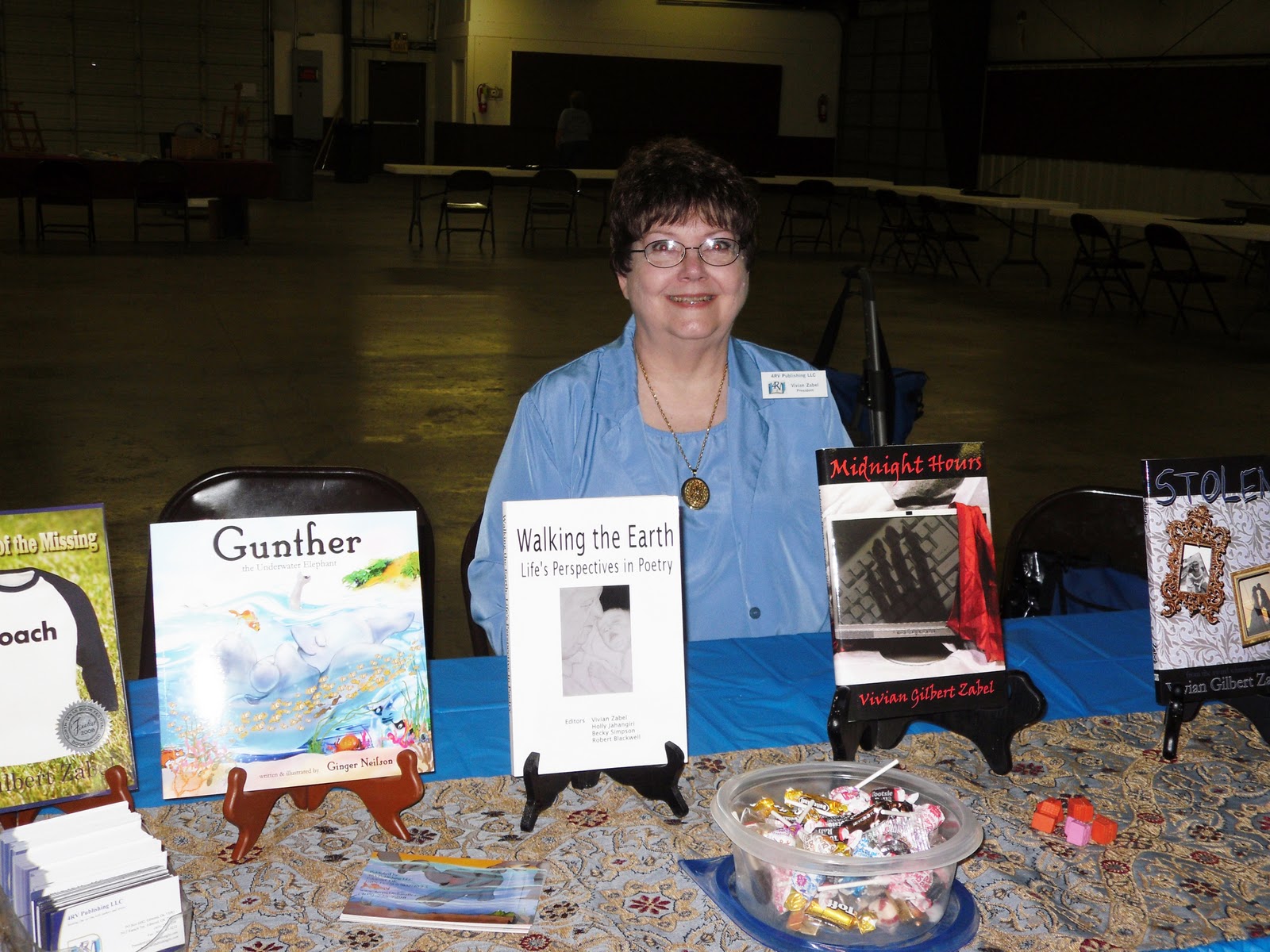
 Vivian Zabel held a workshop on "Make Your Writing Snap" to help attendees have a better idea of what manuscripts need to be appealing to editors, agents, and/or publishers. At least some people attended, even though the workshop was early in the day, soon after the doors opened to the public.
 Jim Laughter's first children's book, and first book with 4RV, made its debut at the festival. Strangers in the Stable also sold more copies than any other book available.